Hey History Hunters and Mystery Maniacs!
Welcome to Revesby Abbey in Lincolnshire, a place with such deep layers of history that you almost have to wipe the mud from your boots just to read the foundations. ‘Are you looking for a good paranormal adventure? Well, this is your place, and you might even like to spend the night (no sleeping allowed) at the Abbey, in search of old bones!
‘The Abbey’ which is a bit misleading because it is in fact a great Manor house – it is also the 3rd great manor house to have been built and improved on at this site; it stands near to where the old abbey or Cistercian monastery used to be. Picture a place where centuries of devotion and silence met the sheer, destructive greed of a Tudor king. Today Revesby Abbey sits in the lovely little village of Revesby in the East Lindsey district of Lincolnshire, England, with a pretty green, surrounded by estate type looking houses and as quiet as any a village you could find, but it too was touched by the Reformation (16th century, major theological movement).
Going back hundreds of years none of this prettiness saving the church of St. Lawrence, (but that was as late as 1891) would have been here. When the abbey came to town; the people living here were paid to leave, leaving the place deserted. The Abbey was built, then dissolved, then the Manor took over. And even now this quaint little village is dominated by the Estate – the Revesby Estate; it has been like that for a very long time and it does seem to have its community at heart, but it is vast, and has a quaint,but commanding feel to this little village.

Going back even further nothing would have been here apart from the Abbey (founded in 1142) which was huge, and if you are trying to see it as I did – you won’t have much luck apart from finding it (and with difficulty, most people in the village didn’t even know an abbey used to be here and there are no signs for it anywhere, but there is useful information in the church) There isn’t much to see anymore and getting up close is restricted by it’s present owners. But an Abbey there was once. Some exploration in the 19th century was done by the estate’s owner at the time and the location site and earthworks were documented. It is said the place, especially at night is not the place to be – however if you are keen on this sort of thing you might fancy a modern Paranormal adventure, and details to these fright nights are listed below.
So even before the dissolution of the monasteries under Henry Vlll things were getting pretty dark for the monks at Revesby Abbey. With tales of the black death sweeping through their abbey and further tales of wrong-doings by some of the monks – only 28 monks and 4 lay-brothers were recorded still living at the abbey in 1377.

After Henry VIII smashed the monasteries, who stepped in to claim the spoils? None other than Charles Brandon, Duke of Suffolk—the King’s own brother-in-law. A grand estate built on the ruins of a sacred space. That alone should tell you something eerie is afoot.
Fast forward through a few ownership changes to the early 1700’s, and a pivotal sale takes place. For what would be absolutely millions today. The estate then passed to the family of a local boy who would one day change the world – Sir Joseph Banks. Joseph Banks inherited the estate as soon as he was 21.
This man, who grew up walking these fields, became the most influential naturalist of his age. He sailed with Captain Cook, helped name Botany Bay, (he travelled with James Cook on several voyages amongst other famous explorers and was a pioneering naturalist, botanist and patron of the sciences)and was a major part in establishing Kew Gardens, acting as advisor to King George III.

But here is where our history gets a little… dark
In 1779, with Britain’s prisons bursting at the seams—a vile, overcrowded mess—Sir Joseph Banks proposed a solution to the Crown. A logistical stroke of genius, perhaps, but one with a deeply sinister undertone – Transport the convicts to Australia.
So the very place where he found his passion for nature, and the place he helped map, was suggested by him as a place to send the unwanted. A man of science solving a social problem by shipping it half a world away! The history of a continent hinges on a single advisory note from a man who grew up on this estate. You could say he was a man of his times, and that he helped establish a colony of convicts in eastern Australia so that British ‘criminals’ could start their lives over in another part of the world rather than perish on the gallows. However belonging to the British gentry gave him lands, titles, and a sense of aristocratic entitlement and there are stories in that he was more than happy to furnish his well-off friends with indigenous human skulls, with no worry about them being removed from sacred sites.
SIDE NOTE – England used penal transportation of convicted criminals- these were usually generally the young and the poor – Jails at the time were run as business ventures. These jails were full of debtors, and they were usually housed with their wives and children; jailers made their money by providing the inmates and families with food, drink and other services, on the whole there were no medical services made available; can you imagine the pain, misery and sadness?

Revesby Hall eventually fell into ruin, but it never truly died. When the last owner, James Bank Stanhope, decided to replace it with a beautiful new house, which today stands very much in need of improvement. The old Abbey had by now been demolished and stones used from it to re-build a succession of houses and walls.
This means that the current Revesby Hall isn’t just near the old Abbey,which was home to the Cistercian order – a religious order of monks and nuns who follow the rule of St. Benedict, this house is literally built from its bones. It carries the echoes of Cistercian chants, Tudor machinations, and the legacy of the man who sent the unwanted across the sea. The stones still stand, but what secrets are trapped inside them?
What Happens at Revesby Today?
If Revesby Abbey is a house built from the bones of a Cistercian past and haunted by the legacy of an empire-maker, what is it now?
Well I’ve been to find out and the magnificent 1845 country house, the third building to bear the name – was badly damaged during World War ll when occupied by the Air force. After the war it was abandoned and fell into a state of severe decay, narrowly escaping demolition in the late 1970’s and today the house is in private hands.

Paranormal Activity
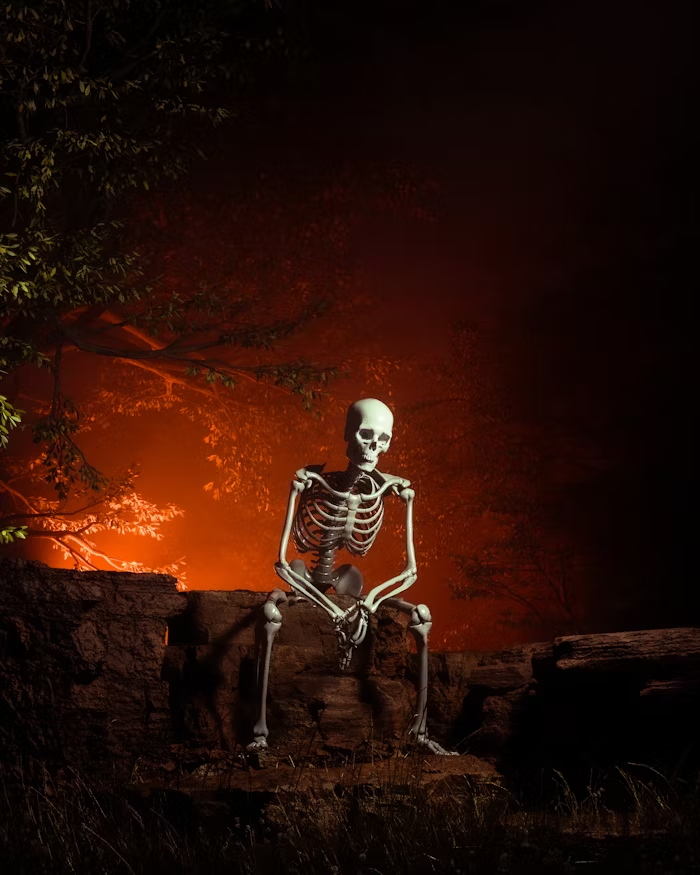
The house isn’t far from the ruins of the original abbey and the graveyard of the monks that once prayed and lived here – lots of skeletons were found in the 1870’s – the monks of the Cistercian order had complex burial rituals, and monks and nuns could be buried with or without shrouds. The order was known for its vows of silence (a personal commitment to develop self-discipline)but it seems they are no longer happy to remain quiet! Ravesby has gained a reputation as one of the UK’s most haunted buildings and the current property has on-going ghost hunts and paranormal events running in the old ruins.
Some have heard footsteps where there is no one to be seen, others report dark figures and darting shapes in the abandoned rooms, chanting has been heard, slamming doors, and a powerful, unseen presence can be felt.

What other UK location do you think is standing on the bones of its own dark history?
Let me know in the comments below! If you have a favourite haunted abbey or a mysterious piece of hidden history, share it—you might see it in my next post!
Until next time dear friends x