9 of the Best Ancient Tree Sites for You to Visit in the UK
The true ancient monuments of the UK—the quietest, longest-lived, and perhaps most mysterious—are not built of masonry, but of wood and bark.
I’ve spent a lot of time tracking down forgotten castles, exploring prehistoric sites, and uncovering the shadowy tales that cling to every old location. But nothing has captured my imagination quite like the silent, sprawling giants of the British woods.
These aren’t just plants. They are living, breathing witnesses to thousands of years of history, often predating the very concepts of ‘England,’ ‘Scotland,’ or ‘Britain’ itself. They’ve watched as ancient man moved from the caves to the great stone circles, witnessed the rites of the Druids, sheltered kings in flight, and stood guard over the graves of forgotten warriors.
The Yew’s Grasp- Not merely trees – but time travellers anchored to the soil
What if I told you that the greatest castles aren’t made of stone, but of cellulose and bark? That beneath the canopy, you are standing in an open-air museum where the exhibits whisper secrets to the wind?
Join me as we journey into the shadows of the UK’s most fascinating arboreal giants—uncovering their sacred lore, sharing the chilling local legends they guard, and revealing the exact spooky locations where you can stand beneath these monumental, whispering sentinels.
The oldest trees in the UK are not just part of the landscape; they are the foundation upon which our legends are built. We begin with the two royal houses of the forest- the eternal, shadowy Yew, and the mighty, majestic Oak.
If any plant could be described as a living monument to eternity, it is the Yew (Taxus baccata). These ancient, often gnarled sentinels defy our very concept of time, with some specimens potentially predating the pyramids of Egypt and witnessing the first migrations of modern humans across the island.
I used to wonder why Yews were almost exclusively found standing guard in British churchyards – The answer lies in their sheer longevity and their dual nature. To the ancient Celts, its ability to sprout new growth from its decaying core symbolised resurrection and eternity.When early missionaries built churches, they frequently did so on existing pagan sacred sites—and those sites were often marked by a pre-existing Yew grove, creating an easy, if ominous, conversion for the local populace.
Yew foliage is very poisonous to livestock, which meant they were protected within church walls and also surviving when most other forests were cleared for agriculture. And offering their ‘protection’ further, the wood from yew was crucial for making the devastating English Longbow, which was a handy device for warding off another sort of enemy!

In the quiet village of Fortingall, you’ll find the oldest Yew tree in Britain—and potentially one of the oldest living organisms in Europe, estimated to be up to 5,000 years old. Local legend claims that the Roman Governor, Pontius Pilate, was born in its shadow while his father was stationed nearby. While this tale is certainly mythological, it cements the tree’s powerful connection to ancient, world-changing history.
The Majestic Oak- King of the Forest
If the Yew represents solemn eternity, the Oak (Quercus) is the reigning monarch of the British woods, embodying strength, justice, and survival. No other tree has influenced Britain’s military power, architecture, and religious customs as profoundly as the Oak.
The religious and political leaders of ancient Celtic Britain, conducted their most important ceremonies beneath their massive boughs. The Oak was their most sacred tree, seen as a direct conduit to the gods.
The Oak literally saved the monarchy when King Charles II hid in the hollow of a massive oak following the Battle of Worcester in 1651. This event cemented the tree’s legend as the ultimate refuge and symbol of national resilience.

Because the Oak was often the centre of ancient village life—a place where law was dispensed and meetings were held—it attracted tales of protective spirits. Folklore warned that trees with massive, hollow trunks housed powerful tree-dwelling goblins or protective spirits who guarded the forest’s secrets. Disturbing the tree or stealing beneath its shadow could lead to severe misfortune. Due to their historical use as meeting places, some Oaks are said to carry the emotional echoes of the judgements meted out beneath them. Stand quietly and you might sense the oppressive weight of old-world court sessions.
9 Must-See Ancient Tree Sites
- The Major Oak, Sherwood Forest, Nottinghamshire . Located within Sherwood Forest National Nature Reserve. The site is managed and well-signposted for visitors. In the legendary Sherwood Forest, this gnarled monster of an Oak is thought to be around 800 to 1,000 years old. : It is most famous as the legendary headquarters and hideout of Robin Hood and his Merry Men. The vast, semi-hollow trunk provided the perfect “accommodation” for a band of outlaws living outside the feudal law. Its sheer scale and legendary history connect you instantly to a powerful figure who represented ancient English justice standing against tyranny—all centred on this magnificent tree.

- The Fortingall Yew, Perthshire Scotland and located in the Fortingall parish churchyard, open to the public. One of the oldest living organisms in Europe (up to 5,000 years old). Legend links it to Pontius Pilate, suggesting he was born here!

- The Sycamore Gap Tree. It is a famous stop on the Hadrian’s Wall Path, accessible via a moderate walk from the Steel Rigg car park (Note: The original tree was illegally felled in 2023, but the site remains iconic, and the hope is for regrowth). This sycamore tree dramatically sits in a dip in the landscape directly adjacent to the ancient Hadrian’s Wall (a UNESCO World Heritage Site).

- The Dark Hedges, near Ballymoney, County Antrim, Northern Ireland. Located on Bregagh Road, publicly accessible, but visitors are encouraged to walk to minimise traffic and damage. An avenue of intertwining beech trees planted in the 18th century to create a dramatic approach to a manor house. Their eerie, twisted appearance made them a filming location for Game of Thrones. Local legend tells of the Grey Lady, a restless ghost who appears at dusk.

- The Birnam Oak, Birnam, Perthshire, Scotland. A short walk along the River Tay from the village of Birnam. Shakespearean Prophecy – A magnificent, ancient oak believed to be the last survivor of the famous Birnam Wood featured in Shakespeare’s Macbeth. Its association with prophecy makes it highly mysterious.

- The Ancient Yews of St. Llonio’s,Llandinam, Montgomeryshire, Wales, Located in the churchyard of St. Llonio’s Church, Llandinam. The churchyard here contains several truly huge, ancient yews, one of which is so old it’s referred to as a Yew maze. Its massive, gnarled structure creates a claustrophobic, spooky atmosphere perfect for tales of spirits.

- The Bleeding Yew, Nevern, Pembrokeshire, Wales. Located in the churchyard of St. Brynach’s Church, Nevern. Miraculous Omen – A yew tree in the churchyard of St. Brynach’s that appears to ‘bleed’ a deep red, viscous sap from one of its branches. Locals have long considered this an omen or a symbol of tragedy, possibly linked to the dissolution of the monasteries.
MORE ABOUT THE BLEEDING YEW HERE
- The Tree of the Witches, Blarney Castle and Gardens, Cork, Ireland. Ireland’s tree of the year in 2019 and situated in the grounds of Blarney Castle is one not miss. Ancient folklore surrounding this old tree, thought to be more than 600 years standing and the Witches Yew Tree at Blarney is steeped in magic, and there are stories of it being haunted. The Blarney ghost Witch is trapped by day but during the hours of darkness can and has been seen. On a lighter note but just as intriguing, If you walk around the tree 3 times, you will be granted the ‘gift of the gab’ ( the skill of flattery or even great eloquence!)

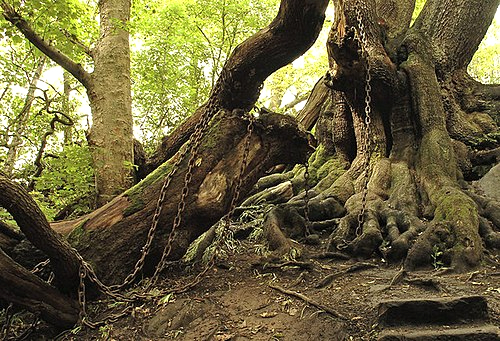
- And last but not least the story of The Legend of The Chained Oak Tree. One of the most famous trees in the UK is both ancient and creepy, and with a definite tale of death and curse attached—it is The Chained Oak in Staffordshire, England, This formidable English oak tree is estimated to be around 700 years old and is wrapped in heavy, rusted iron chains. The chains are not for support but are a desperate attempt to contain a centuries-old curse. The legend centers on an arrogant member of the Talbot family, the Earl of Shrewsbury, who lived at the nearby Alton Towers estate (now a theme park). As he was riding home in his carriage one night, he encountered a ragged old woman (sometimes described as a witch or beggar). She begged him for a coin, but the Earl cruelly dismissed or refused her. Spurned, the old woman raised her staff and placed a wicked curse upon the Earl: “For every branch that falls from this old oak tree, a member of your family will die.” Unbelieving, the Earl continued on his way. That very night, a violent storm broke out, tearing a single branch from the great oak. True to the curse, a member of the Earl’s close family mysteriously and suddenly died. Terrified, the Earl immediately ordered his servants to gather all the available chains and bind every remaining limb of the tree, securing them to the trunk to prevent another branch from falling. The tree has remained chained ever since. The enduring image of the gnarled, ancient oak bound in iron is what gives the site its deeply unsettling atmosphere. It stands on a public footpath in a wooded area near the village of Alton, Staffordshire, close to the entrance of Alton Towers Resort. Visitors can walk right up to the tree to see the heavy chains, which are now deeply embedded into the bark of the ancient oak as it continues to grow. Visitors can walk right up to the tree to see the heavy chains, which are now deeply embedded into the bark of the ancient oak as it continues to grow.

The spooky tale is so entrenched in the local history that it even inspired the popular dark ride Hex – The Legend of the Towers at the nearby theme park!

From ancient beliefs to modern entertainment the tree is indeed the ultimate time traveller. Have you got a tree with a character etched in them? Here below I have shared a few with you who I believe are real characters and got a real story to tell.


Until next time dear friends x Share this story and your own tree pictures ……..