The tale of the hanged woman of the Edinburgh Pub and 7 great places for you to stay, whether a lone- traveller, family or looking for a romantic break.
Content
- What Edinburgh was Like in the 18th Century
- Half- hangit Maggie – A local legend
- A Scottish Welcome: 7 Great Places to stay near Grassmarket, Edinburgh
The UK is a treasure trove of ancient Inns and taverns, many of which have stood for centuries with their foundations laid upon a patchwork of human history, mystery and in this case Scottish folklore.
Unlocking the past is sometimes as heartbreaking as interesting; but the tale of Margaret Dixon will leave you with a real feeling of horror for a tale not so very long ago; of story of the hanged woman of the pub.
And if you want more and are thinking of seeing this fine city first hand, I have put together a list of a few of the best places in the Grassmarket area to stay in.
What Edinburgh Was Like in the 18th Century
The legend that is,of the hanged woman of the pub – is a true tale and just one of the many hangings in the Grassmarket area of Edinburgh. We will explore this area when at the time Margaret (Maggie) Dixon was hung to death, and as it is now, today.

Grassmere would have been Edinburgh’s main market places
To give you an idea about Grassmarket back in the 18th century it was then known to be the place of public executions (there is a memorial at the sight remembering the ‘killing time’ between 1661-1688 when more than 100 people were hanged for religious differences between James VI and his son Charles 1. Want to know more? HERE.
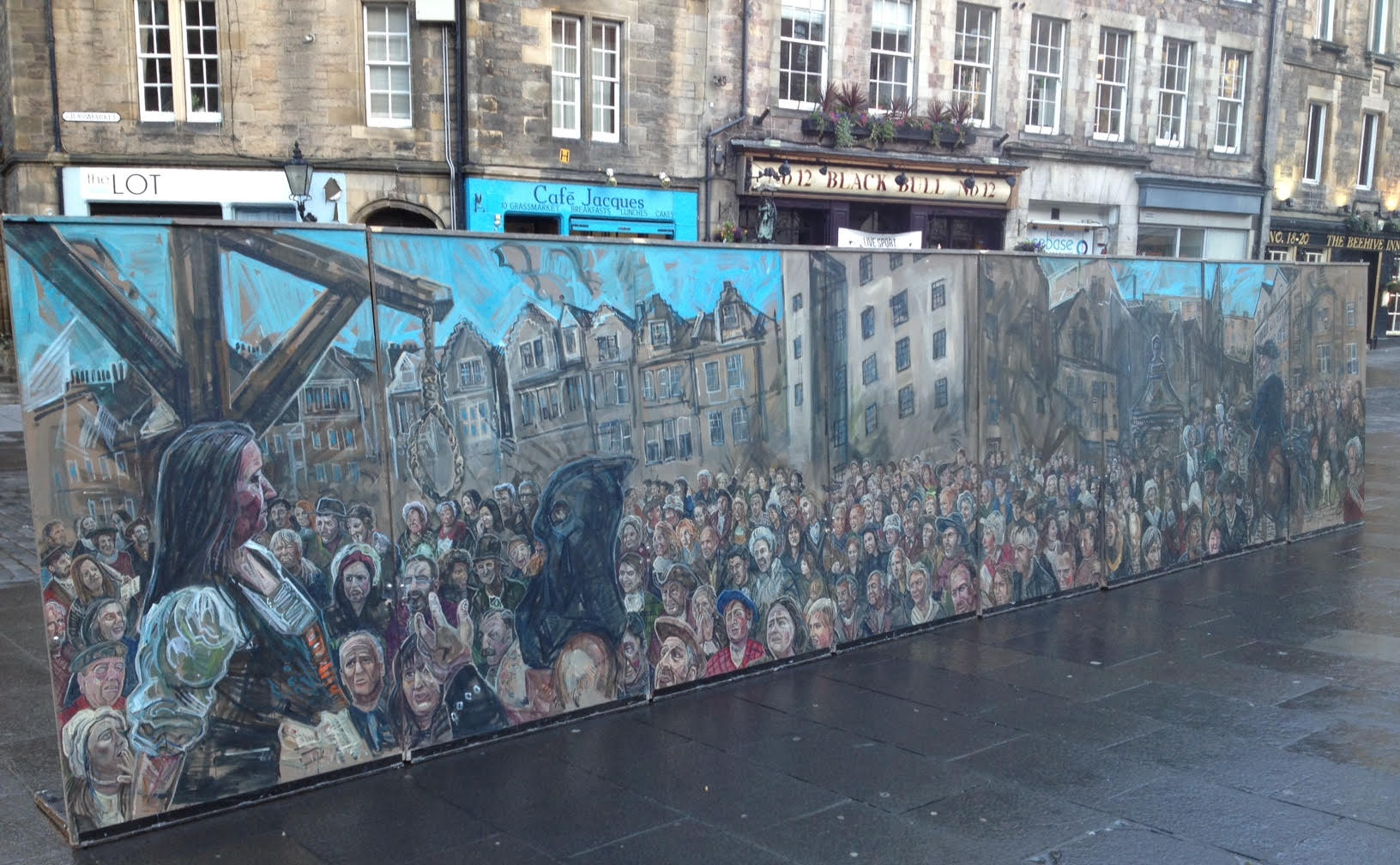
So people would have been going about their daily business in the sight of this full horror. I have been given kind permission to use images for this page. This mural image gives you a good idea of the scene of the times. And I guess a hanging although not a very nice thought for us today, back then was looked on as justice, and something which had to be done. However there are always those who enjoy this type of thing and it is said shop-keepers and residents would hire out their bedroom windows around the gallows for a better view of the atrocity.

Grassmarket lies below the Castle and in a bit of a ‘hollow’, which is well below surrounding ground levels.

Today it is an events and vibrant street place, where lots of entertainment, hotels, and eating and drinking can be had. A favourite today for painters and photographers and one of the best views of the city and the castle. And rather beautiful to look at, with swathes of happy people drifting by, taking pictures of what once would have been a very different feel to this place.
About 400 years ago, when Grassmarket would have been one of Edinburgh’s main market places, it was a crazy-busy ‘horse market’ or ‘grass market’ within a open grassy area, which was given over to the sales and trades of livestock. Merchants, traders and ‘pop-up’ stalls sold such things as paints, colours, dyers, drugs, woods, tar, oil, hemp, flax, iron and heavy goods, all supplying the wider countries shopkeepers, Grassmarket would certainly have had the same vibrant feel it has today. Monetising all this footfall were the Inn keepers, then public houses (pubs), many of these being the sale of home-made brews from their own homes, taverns and temporary lodgings holders.

Pubs (from the word – Public house) have been places of merriment and scandal and sometimes even the macabre. Their walls hold secrets that whisper in their draught,(forgive the pun) but still there’s nothing quite like an historic British pub.
Can you imagine Edinburgh, Scotland at the time – 1728 and how this city would have looked then?

Generally the people were starving,and contained within its medieval walls there was overcrowding. It was dirty and unsanitary, there was no sewage system or piped water, and ‘disposal’ was a major problem. Human and animal waste lay in huge piles in the streets. Disease and illness were everywhere and epidemics of Typhoid, Smallpox and Typhus led to a low life expectancy.
It’s a no-brainer the pub was a popular place to hang out! With lots of pubs (known then as taverns or alehouses) a warm crackling fire, sturdy wooden table and a bench on which to set your brew would have served as a major comfort in what was a harsh environment to live.
Before new modern suburbs to the south of the old town began to spring up in the 1750’s and then more building being laid to the north of the castle in the 1760’s, Edinburgh was thus beginning to witness the dawning of the ‘Age of Light’ – Edinburgh was a a pretty scary place to be.
Today it is a social, economic and intellectual city with a great university, a fantastic art scene, food, drink, festivals and accommodation, and more to boot.
The city back then and even before the 1700’s had the reputation from visitors as being the filthiest city in Europe. It was a crime-ridden, stinking place with little for the poor, with a life filled with petty crime or just making-do in order to eat or feed your family. Often though people migrated from the small surrounding villages to capitalise on the better conditions on offer in the town over an even harsher existence in the country.
It’s not hard to imagine rats competing with children for food; children filthy, starving, ill, bloodied and even lonely.
The warm glow of the fire, the clinking glasses and the hum of conversation: it’s a feeling of comfort and history all rolled into one. But for some of these venerable establishments the past isn’t just a memory it’s a living breathing and sometimes ghostly presence.

Some of Scotland’s oldest Pubs
Here we unlock the past and delve into the dark, fascinating and utterly captivating history of some of Scotland’s oldest and intriguing pubs, and how one of them got its name.
Edinburgh is a City full of secrets And this pubs history is steeped in mystery and ghostly lore, our famous story from the 18th century concerns Margaret Dixon a woman who was hanged for infanticide in Edinburgh.
Infanticide is ‘an intentional killing of a infant or offspring’ – a mother kills her child here in this true story but the hanged woman of the pub mystery is fascinating- Poor Margaret though I don’t think was a murderer just a child herself who was so poor and without any support she was likely in complete despair.
The Story of Half-hangit Maggie
There are a few versions of this story but Margaret Dixon was a 21 year old at the time, in about 1723, and likely to have been very familiar with the street trade of Edinburgh; possibly taking her trade (fish or salt)of either her family or hers there for the weekly auctions or stall markets.
Hawker (street sellers, who can gather up their goods and make a run for it; thereby paying no rent or tax) would have been a constant sight in the market areas of vibrant market towns shouting their wares – salt-wives or salt-crying hawkers were just one of many ways to make a bit of an income.
Margaret was raised to strict parents in the town of Musselburgh (then Mugsleburgh) a few miles east of Edinburgh. ‘Mussel’burgh refers to the shellfish trade. When she was old enough Margaret was married to a fisherman – in some accounts I have read she had two children. I think she would have made her way at some time to Edinburgh from Musselburgh in order to make some money after her husband left her to go on his seaman duties. There is an account she worked as a bar maid at a tavern in Edinburgh and In time Margaret was ‘acquainted to a man who seduced her’ and the consequences were she became ‘with child’.
As she was married, but her husband was away, it is said even though she tried to conceal the pregnancy people knew she was ‘hiding something!’ Margaret while in prison awaiting her trial was ‘extremely penitent’ and that she acknowledged she had in many instances neglected her duty, and likewise she had been guilty of ‘fornicastions’. Her reason for concealing the birth of the child was for fear of being made a “public example’ in the church, and a “laughing-stock to all her neighbours”.
Concealment of a child was illegal ( and still is) and she was charged with The Contravention of the Concealment of the Pregnancy Act (illegal to hide a baby/not register it) It also could carry the Death Penalty.
The story started unfolding when a new born baby boy was found dead on the grass banks near a river not far from her Musselburgh home.
The whispers about Margaret having been suspected of being pregnant and now wasn’t, began to escalate, and a finger was soon pointed her way. When questioned Margaret says she was suddenly taken into labour, sooner than she expected and her agonies not only prevented her from getting assistance but also left her in a state of insensibility, so that what became of her child she could not say.
Was this Margaret’s first child? an inexperienced young woman in a harsh, confusing, unforgiving world? was she maybe protecting someone else trying to help her?. Perhaps the baby was stillborn or too premature to survive and she panicked?
Margaret constantly and steadily denied she had murdered her child, or could even form an idea of doing such a thing. She said she had been guilty of many sins but taking the life of her child would never had entered her mind.
The surgeon in charge of the autopsy said the baby had actually been born alive; and then had been drowned (in the river?). His findings for this were based on the fact that the child’s lungs were put in water by him and ‘they floated’ which could only have meant one thing; the baby had breathed after it was born.
This evidence was put to the judge and although murder could not be concluded Margaret was guilty of concealment and found guilty anyway, and judgement passed that she should be hanged to death.
The lively, high-spirited city of Edinburgh was packed full with people hanging out of windows in order to see Margaret hanged that day. This image is captured here in the work of Chris Rutterford, he is an artist living and working in the city today and known for his great murals.

So after the chanting, sobbing, spitting and possible shouting (for or against Margaret; who knows?) Margaret’ was hung and then after her poor strangled body was cut down and put in a plain wooden coffin and onto a simple cart by her family to be taken back and buried in Musselburugh. On the journey back it is said the party stopped a few miles away at an Inn for some refreshment.
What happened to Margaret of Musselburugh?
The Inn in question was in a place called Peffermill which was a significant site near Edinburgh with a Manor house and thrashing Mill, the site was also associated with paper making. However there is some suggestion it might have been the Sheep Heid Inn, which also claims to be Edinburgh’s oldest pub. It has been serving drinks since the 14th century and a great visit nowadays with its low ceilings and exposed beams is a must.
It has a refurbished old Skittle Alley which was a popular game in ‘the old days’ which was first played outside then brought into the public houses for an all year round entertainment. There has been an Inn on this spot since 1360 and the name is likely derived from the fact that a royal gift – a ram’s head snuff box made of gold was presented to James VI of Scotland at the time. Before this time I am unsure what the pub was called. Famous visitors to the pub include Margaret Dixon, Mary Queen of Scots, Robert Burns, Elizabeth II, and Robert Louis Stevenson!

The pub itself is said to be haunted by a few spirits and an apparition of a man possibly a former landlord has been seen standing near the bar quietly observing the patrons, there is also a ghostly figure of a young girl near the pub’s famous skittle alley bowling Lane, and has been seen by many.

Now getting back to the story – While quietly being refreshed one of the party heard noises or scratching sounds coming from the coffin on the cart. Everyone being terrified to look within, an old gentleman volunteered to open the lid, as he did Margaret sat bolt up right scaring everyone half to death!
“No be so feared!” Margaret said weakly. “It canna be Maggie”, it’s her ghost”, “oh save us, save us”, shouted Mrs. Murray…..
It was said Margaret was taken to the old man’s home and ‘bled’ ( a method of draining a person of some blood to either purify or relieve them of their disease!). In the morning she found she was well enough to walk home.
Under the Scottish law you cannot be tried for the same crime again – so Margaret was free, she had paid her price and now she could live her life out. Margaret (Maggie) Dixon became quite famous and gained the name Half-hangit Maggie. She had to be saved by family and friends many times in the village as people wanted to know the story and would bother her constantly for her version of things.
Eventually when her husband (John, the seaman who came back into her life) died, Maggie moved back to Edinburgh with her now 2 children with John, and opened her own Inn. She still had the reputation of the woman who was ‘half – hanged’ but I’m sure she became not to mind especially as it must have brought the customers in!
Maggie lived for another 40 years after her traumatic experience
There is a nice little pub named after Margaret – The Maggie Dixon, it looks onto the market place in Grassmere where Maggie was hanged and remarkably got away with her life! Justice?, luck? trickery? (some claim she knew the noose man, who was generous with the rope).
The Maggie Dickson Pub

Want to see more of the Grassmarket or looking for somewhere to stay close by?
7 Great Places to Stay in Edinburgh
The Double Tree by Hilton is where I stayed last(2025) and really couldn’t fault it. Rooms are comfy, clean and bright. HERE
The Kick Ass Hotel and Bar – Hostel type accommodation, young vibe, fun. HERE
Hotel Du Vin – Looking for something a bit up-market? Modern, classic, bistro dining. HERE
Apex Grassmarket Hotel – Want great views of the cathedral? Something with a gym, pool, and sauna?And family friendly HERE
Virgin Hotels – Contemporary design in a 19th century building! HERE
The Radisson Collection – With traditional Scottish flair, they say a warm welcome awaits you! HERE
Stay Central Hotel – Boutique style, this little place offers a free bottle of proseco and best rates when booking. HERE
Until next time dear friends x