St. Micheal and All Saint’s church Haworth
St. Micheal and All Saint’s church Haworth is just as much of a “must-see” today as it was back in the Victorian era, when sightseeing first really became a thing. Discover the dark history of Haworth church, or ‘Patrick Brontë’s church’ and a father’s grief.
In the 19th century the Haworth’s church was becoming a major health risk, it was said to be overflowing inside with ‘grave water’. And something had to be done about it, people were starting to come and see for themselves the place where the famous Brontë family lived and died; and this place of worship was in need of a make over.
You might not guess it just by looking at it, but the building we see today was almost totally rebuilt. Work started on the church in the 1870’s and finished in 1881, paving the way for a much better visitor experience!
The church had become a big pilgrimage site for Brontë fans, local and afar and there was a huge public outcry when the rebuild was announced—people were terrified of losing that physical connection to the sisters. To keep that history intact, planners were careful to preserve and seal off the family vault beneath the church, which serves as the final resting place for almost the entire Brontë family.

Certain items were saved and can still be seen today from the original Brontë church ( as it is lovingly referred to) – such as the Brontë memorial tablet, the communion table, and the brilliant chandelier.
If the church hadn’t been rebuilt, it might have collapsed entirely or been forced to close its doors permanently. The rebuilding ensured that the site remained a functional, living parish church rather than a derelict ruin. It is said that this ‘grave water’ from as many as 40,000 burials began leaking into the church causing filthy, putrid and corrosive floods eventually damaging the whole church itself.
The Brontë Family Vault
The only one not in the family vault is Anne, who died of tuberculosis in the seaside town of Scarborough; she was buried there to spare her grieving sister Charlotte the agony of a long journey home with a coffin. It’s a tragic thought that their father, Patrick Brontë, outlived his wife and every single one of his six children, enduring a lifetime of profound loss.
To stand at the top of Haworth’s steep Main Street is to stand at the edge of a graveyard that eventually rested a dynasty. While most pilgrims climb this hill to trace the footsteps of the Brontë sisters, the true ghost of St Michael and All Angels’ is the man who outlived them all: Patrick Brontë.
After a number of curate appointments Patrick met Maria Branwell, a wealthy merchant’s daughter. The couple were married in 1812, and their large brood quickly followed.

- Maria Brontë was born on April 23, 1814, and died at the age of 11.
- Elizabeth Brontë was born on February 8, 1815, and died at the age of 10.
- Charlotte Brontë was born on April 21, 1816, and died at the age of 38.
- Patrick Branwell Brontë was born on June 26, 1817, and died at the age of 31.
- Emily Jane Brontë was born on July 30, 1818, and died at the age of 30.
- Anne Brontë was born on January 17, 1820, and died at the age of 29.
It is a sobering list – especially considering that the eldest two died just months apart as children (and by then without a mother) and the remaining four all passed away before reaching the age of 40.
Born on St. Patrick’s day, Patrick Brontë had come from a poor Irish family but spent most of his life in England, and a large majority of it as the parish priest ( Anglican) for St. Michael and All Angel’s Church here in Haworth. He raised his family in a house you can still visit today, a stone’s throw from the church.
Sadly, after less than one year in their new home and his new role as curate at St Michael’s, Patrick’s wife Maria passed away.
It must have been a devastating blow, left with six children all under the age of eight, Patrick felt he had no choice but to soldier on. Thankfully, he wasn’t alone; Maria’s sister, Elizabeth Branwell, stepped in to help. ‘Auntie Branwell,’ as she was known to the family, moved in to keep house and help raise the little tribe. She became a fixture of the parsonage, dedicated to looking after his children.

It is easy to imagine the Brontë parsonage as a place of strict, Victorian confinement, but for Charlotte, Emily, and Anne, it was actually a haven of intellectual freedom—and that was entirely down to Patrick.
While many fathers of the era expected their daughters to focus solely on needlework and domestic management, Patrick treated his children as intellectual equals. He brought home newspapers from Leeds, encouraged them to debate politics, and gave them free rein of his extensive library. He didn’t see their vivid, imaginative worlds of Angria and Gondal as a “waste of time”; he saw the fire in their minds and did everything he could to fuel it. By fostering a home where ideas mattered more than social convention, he gave his daughters the tools they needed to challenge the literary world. He was the first person to read their work, the first to believe in their talent, and the quiet architect of a genius that would eventually outlast the very stones of the church he served.
Patrick Brontë lived a life caught between deep faith and heartbreaking loss, but he remained the steady rock for a family whose incredible—and tragically short—lives changed literature forever.
Being the backbone of the Brontë family meant much more than just living under the same roof. It meant balancing the quiet, scholarly life he craved with the relentless demands of a parish that was often struggling to survive. To see how he held everything together, you have to look at how he spent his hours—from the moment he stepped out into the damp morning air of the churchyard to the quiet, disciplined evenings spent by the parsonage fire. This was his world: a life of constant service, where the heavy weight of his responsibilities was always tempered by his deep love for his children.
Patrick Brontë was the eldest of 10 children and it seems he was determined to make something of himself, after several apprenticeships for positions of linen draper, blacksmith and weaver, Patrick eventually trained in the clergy after a friend saw potential in him. He went on to become a teacher. Then in about 1802 moved to England after winning a scholarship to study theology at St. John’s College in Cambridge. It seems he changed his name about this time from Brunty to Brontë; a good move I think.

A Day in the Life: The Parson of the Moors
When we visit the quiet, stone-paved aisles of St. Michael’s today, it’s easy to get lost in the tragic beauty of the stories his daughters left behind. But perhaps we should also pause for the man who remained. Patrick Brontë was a survivor in the truest sense—a father who poured his energy, his intellect, and his unwavering faith into his children. Stop for a minute to reflect on the day-to-day life of a dedicated man ………………………
- 07:00 – The Morning Salute – Patrick starts his day by firing his pistol into the air (learn more about this in the Haworth museum)It’s a habit from the Luddite riots—a daily ritual to clear the barrel and ensure his home is protected.
- 09:30 – The Parish Rounds – He navigates the crowded churchyard to the church. In a village where the average life expectancy is just 25 years, his days are often filled with the solemn duties of burying the young.
- 11:00 – The Radical Reformer – Patrick isn’t just praying; he’s writing. He is a fierce advocate for public health, lobbying the government for better water and sewage systems to save his parishioners from disease.
- 13:00 – The Schoolroom: – He visits the school he helped build, ensuring that the local children have the gift of education.
- 15:00 – Pastoral Care – He climbs the stairs of cramped cellar homes to sit with the sick and dying, bearing witness to the hardships of his community.
- 18:00 – Intellectual Dinner – Back at the parsonage, he encourages his children to discuss politics and literature. He treats his daughters not as subordinates, but as intellectual equals.
- 21:00 – The Clock Ritual – He locks the doors, winds the grandfather clock—the heartbeat of the house—and reminds his children: “Don’t be late up, girl’s”.
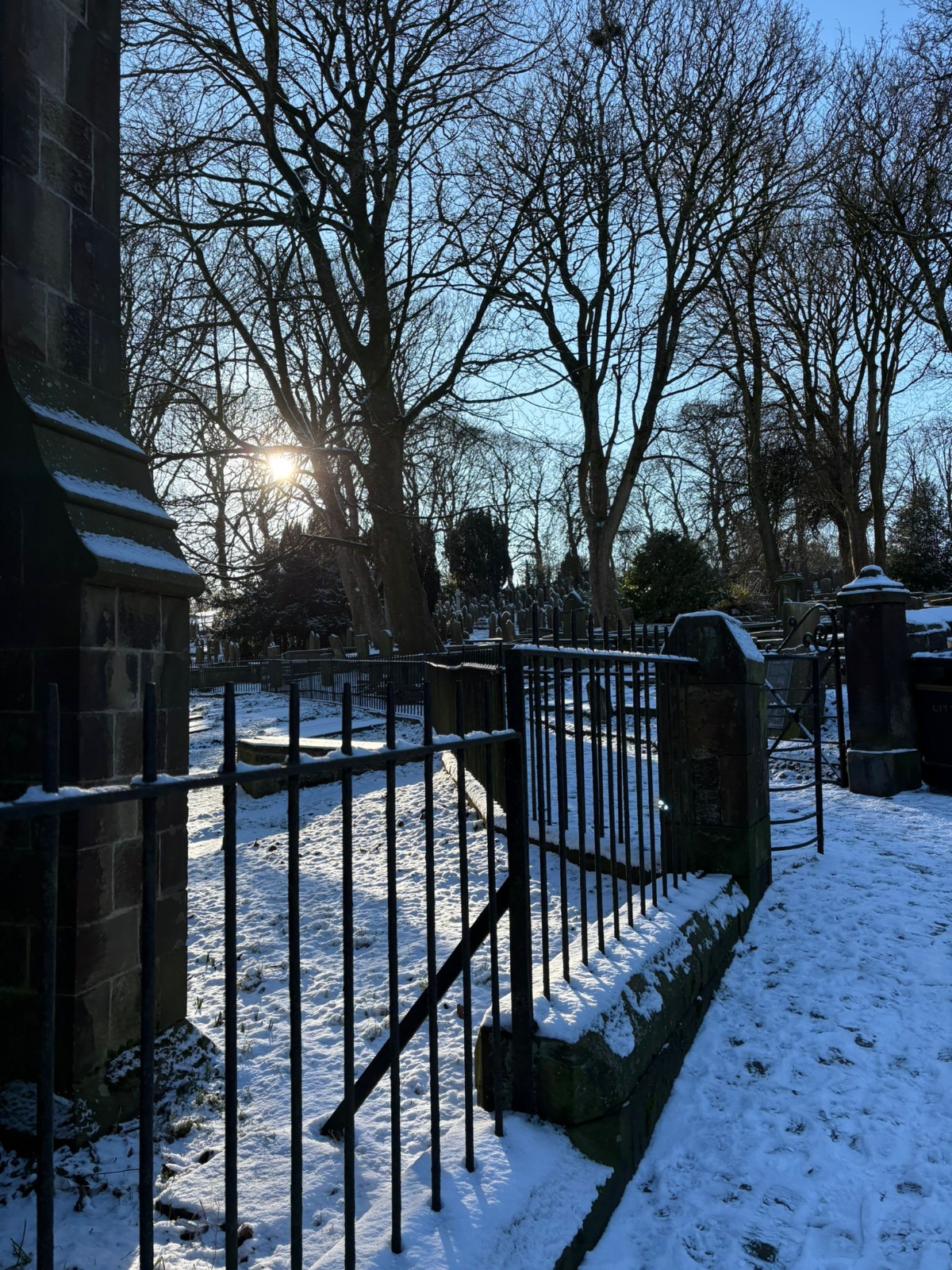
It is a very atmospheric place—when you walk through the graveyard, you are literally walking over the history that shaped the dark, moody landscapes of Wuthering Heights and Jane Eyre –Thank you Charlotte and Emily x ……….
……not forgetting Anne Brontë who wrote The Tenant of Wildfell Hall amongst other great things.
A Few Things to Look out for When Visiting Haworth
The Charlotte Brontë Stain Glass Window – Located in the church of St. Michael and All Saint’s Haworth. This lovely bright window was dedicated to the family by an “American Citizen” who greatly admired her work. It is often said that although Charlotte changed the world of literature, who knows iwhat she would have achieved if her life wasn’t cut short by what would have been a disease filled era. The longest-lived of the siblings, Charlotte died while pregnant, officially of hyperemesis gravidarum (extreme morning sickness), but the role of underlying tuberculosis likely played it’s part in her early death.
Patrick Branwell Brontë – (Patrick’s only son)it is said drank too much alcohol – and took too many drugs to help his mood, these drugs were easily obtainable from the local ‘Druggist house and shop’, which you can still see today. You also see Branwell’s (as he was affectionately known)favourite seating area in his favourite pub in the village, The Black Bull just opposite the church.
Branwell was in his own right a poet and a writer, unfortunately he too was a victim of the times in which he lived and his story serves as a poignant reminder that while the Brontë sisters faced the hardships of being women in a patriarchal society, Branwell faced the specific ‘masculine’ hardship of being the family’s primary hope in an era that offered no safety net for the sensitive or the struggling.
The Brontë Waterfalls
Get some inspiration for your own next poem or novel here at these lovely waterfalls. Walk the Top Withen’s, said to be the sisters’ favourite walk – walk along the bridge and explore as they did. And better still after a heavy downpour of rain, experience the falls in all their glory, you’ll find the moors just outside this picturesque village of Haworth. The Moors today are as the Brontë’s would have walked them one hundred years ago.

As I write this on Mother’s Day 2026, I’m thinking of Patrick, but also of the woman who made him – his mother, who ever she was, a woman lost in time – raising ten children amidst the poverty of 18th-century Ireland; I think maybe that kind of maternal strength might have been the silent foundation of the entire Brontë legacy.
Until next time dear friends x