Capabilty Brown, a church and a Pilgrims Legacy
If you find yourself wandering the mist-heavy banks of the River Great Ouse in Cambridgeshire, look upward. Perched on a rare rise of land—a staggering 13 meters above sea level—stands the tall sentinel of the Parish Church of St. Peter and St. Paul. For nearly a millennium, this stone titan has watched over Fenstanton, serving as both a spiritual anchor and a literal lighthouse for the weary. Not just that but you’ll find Capability Brown buried there.
Fenstanton is a low-lying flood prone village. In the 1630’s the Earl of Bedford and Dutch engineer Cornelius Vermuyden pioneered and put together plans to drain the Fens, the drainage was to allow the transition from wet fens to farming, producing wheat, barley, chicory and potatoes. The village has strong links to the River Ouse, with its boundary extending to the river and historically including the area near St. Ives.
The Master of Landscapes Returns to Earth
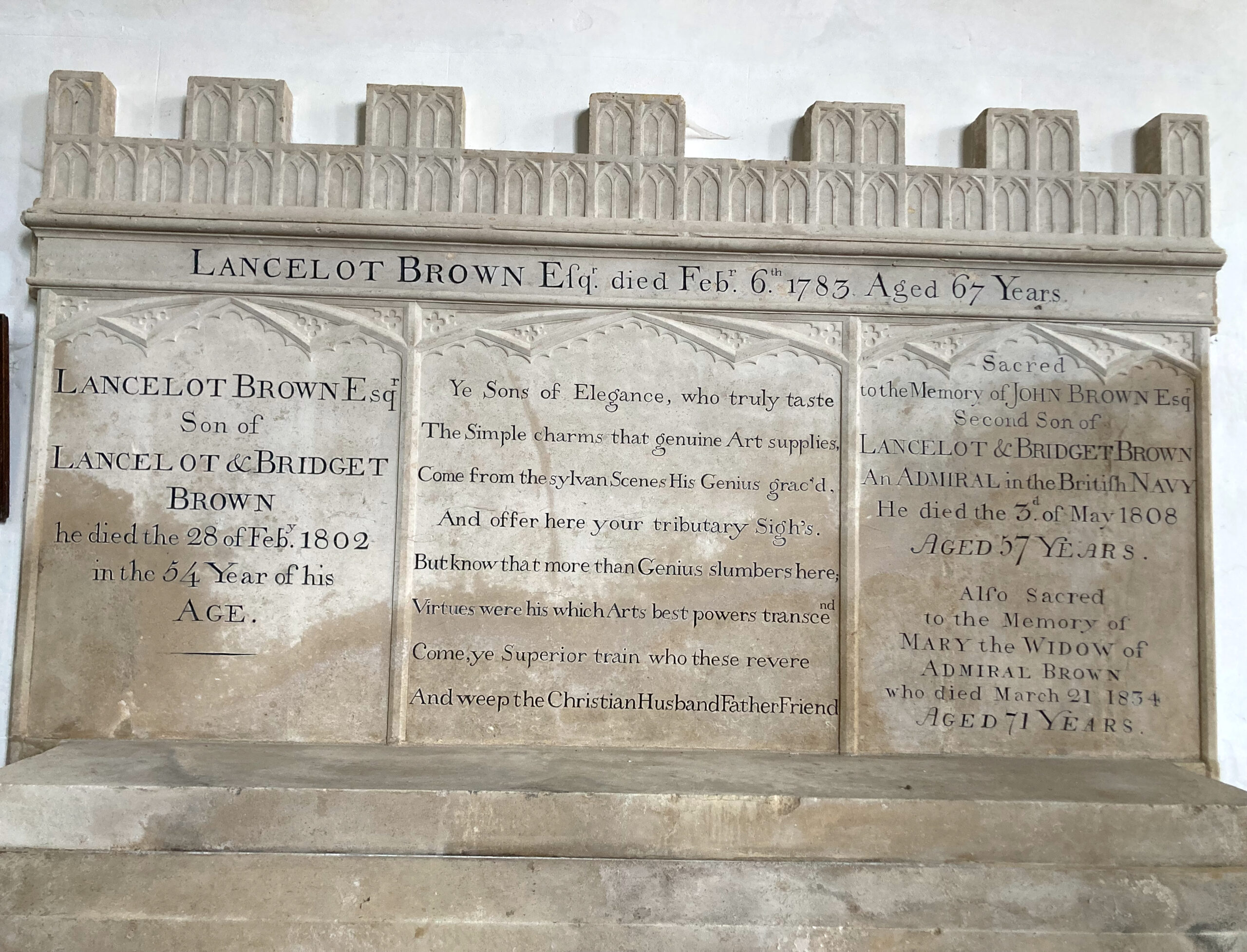
One of Fenstanton’s greatest claim to fame lies in that soil exposed by the drainage. This is the final resting place of Lancelot ‘Capability’ Brown, the man who defined the “English garden” and reshaped the grounds of Blenheim Palace and Highclere Castle. Their family memorial can be found within the Chancel of the church.

In 1768, Lancelot Brown purchased the Manor of Fenstanton and Hilton in Church lane Fenstanton for £13,000, assuming the title of Lord of the Manor. While he spent his life bending nature to his will, nature eventually claimed him back as it does us all.
From the newish, well kept headstone and grave outside to the grand family memorial within, every inch of this church tells the sweeping story of Capability Brown’s life, death, and lasting glory. The chancel is large and is as long as the nave, which is unusual and feels more like a cathedral than a village church – on the left of the chancel is the memorial to Lancelot Capability Brown and some of his family.
Step outside to the north side of the Chancel to find the headstone where Brown and his wife, Bridget, lie in the very earth he once sought to master.

A Beacon in the Dark
The church you see today is a tapestry of time. While the Domesday Book of 1086 confirms a church stood here nearly 1,000 years ago, the current structure features 13th-century bones and a 15th-century finish.
In the Middle Ages, the church served a darker, more vital purpose. As the highest point in the region, it acted as a navigational landmark for sailors navigating the dark waters of the Ouse toward the port of St. Ives. It is whispered that a beacon fire once burned atop the tower—a lonely light guiding travellers through the treacherous Fenlands.
Fenstanton to the White House
Inside the quiet interior of today’s churches, history takes an unexpected turn toward the New World. A memorial honours John Howland,(born in 1599) a Fenstanton local, who famously sailed on the Mayflower and bravely left his provincial life in this Fenland village to break away from the conventional church and join other like- minded people to start a new life with their own values across the waters.
Howland’s survival was something of a miracle though (he was knocked overboard on the Mayflower during a storm and survived by grabbing a halyard), and his lineage changed the world. His descendants include, Franklin D. Roosevelt, Richard Nixon and Winston Churchill to name a few.
Fenstanton’s Architectural Curiosities
As you walk beneath the 15th-century timbers of the nave, look up. The joints are adorned with “curious heads”—carved faces that have watched over the congregation for six centuries. These silent, wooden witnesses add a touch of the uncanny to the atmosphere, especially when the sun begins to dip below the horizon as it did today.
As well as the beautiful old stained glass windows, you’ll notice a modern ‘Millennium’ Window which to my eyes is just as stunning as the glass you’ll notice over the altar.
The Tower is the oldest part of the building – 13th century. The huge buttresses were put in when the tall 14th century arch was added to the tower. Look up here and you’ll notice a carved stone head of a man sticking out his tongue, not called grotesques for nothing! and in the centre of the west arch is a carved head upside down, I wonder what Mr. Brown thought of all this?
Read our chronicles on Cambridge: A City’s legends and Landmarks A Guide
Look for the west door it too has two carved heads on the hood moulds.
Going back up to the altar you will see the Sedilia (built in seats) and Piscina ( a type of sink with a drain, where the Communion vessels were once washed)- these carved stone seats set into the stone work were used by the clergy in pre-reformation times during long sermons. The sanctuary floor has been raised since then making the seats now look strangely low.

The whole churches stone itself tells a story of immense labour; the Barnack stone was transported all the way from Northamptonshire via the river, then hauled up the hill to create this “enormous” sanctuary.
Before I go and for those of you that like your history older – while in Fenstanton I learned about Queen Joan of Scotland. She lived here for a while, she was the third child of King John of England and her mother – Isabella of Angouleme. Joan was married to Alexander ll of Scotland in 1221 in York Minster. She became known as the Queen of Alba.
Her time in Scotland was not a good one, her position in the Scottish courts was weak and mainly dominated by her mother-in-law, Ermengarde de Beaumont.
After some time Joan and Alexander became estranged, her position was stronger for her connection with England and she wished to spend more and more time there, her brother King Henry lll who grated her lands there, in Yorkshire, Driffield and Fenstanton. Needless to say there is nothing but the vestiges of what once was a moat around the manor – to find it – look out for the clock tower at the bottom of Church lane – there are plenty of information boards scattered around.

Joan died young at 27 – it is said in her brother’s arms, they were close and in her memory he built her a a splendid marble tomb to honour her at Tarrant Crawford Abbey in Dorset where it was her wish to be buried. This Cistercian Abbey was once the richest in England, now ruined. But the church that stands by it today, St. Mary’s – is said to have her in a Gold Coffin somewhere in the graveyard.
Whether through the legacy of a landscape architect, the survival of a Mayflower pilgrim, or the quiet residence of a medieval Queen, this ‘enormous’ sanctuary remains a timeless bridge between the muddy banks of the Ouse and the vast currents of world history.

Until next time dear friends x