Crows – their legends and Folklore
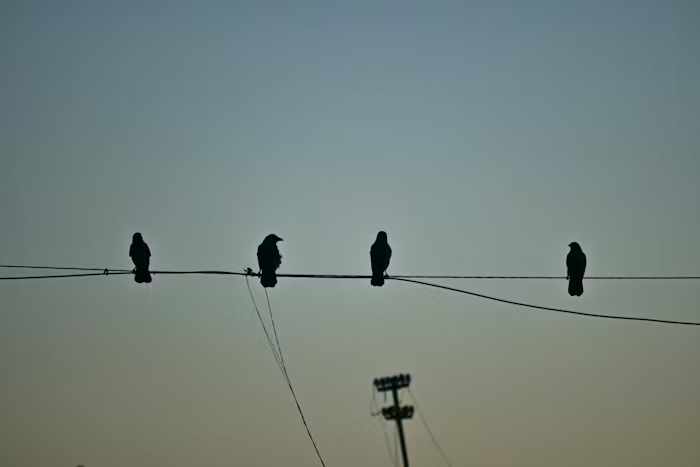
You see them everywhere, a flash of inky black against the sky.
Perched on a telephone wire, strutting across a park lawn, or cawing from a distant treetop. We’re so used to them, we barely give them a second thought. But what if I told you that this familiar bird, the humble crow, has a history in the UK so rich and deep it would make your head spin? From ancient Celtic tales to surprising modern-day facts, the crow is so much more than just a feathery shadow. Here we look at their legends, history and folklore, and of course their Celtic connection.

The Crow Mythology – UK Crows and 3 Short stories for Kids
While they might not have a king who sleeps under a mountain like a certain Welsh dragon, crows have their own share of UK legends. One of the most famous is the tale of the Crow of Wales. According to folklore, if a crow lands on a house, it’s a sign of good fortune.
However, if a crow lands on a grave, it is said to be a sign that the soul of the person buried there is not at rest. A bit of a chilling thought for your next graveyard walk, eh?
Then there’s the more whimsical side. In some parts of the UK, hearing a lone crow caw three times is considered a sign of an impending birth, while a gathering of crows (known as a “murder of Crows”!) is a sign of bad luck. It seems we’ve always been conflicted about these birds, seeing them as both an omen of ill-fortune and a symbol of good luck.
A Touch of the Dark Side – The Celtic Connection
But let’s start where a lot of our UK folklore begins: – with the Celts. For them, the crow wasn’t just a bird; it was a powerful symbol, a messenger, and sometimes, a harbinger of war. They were seen as linked to the Morrigan, a formidable figure in Irish mythology often depicted as a goddess of war. fate, and death. Morrigan could transform into a crow, observing battles from above, a silent, dark witness to the chaos. So, if you ever spot a lone crow watching you from a distance, maybe give a little nod of respect. You might just be in the presence of a very ancient spirit!
The Morrígan is one of the most powerful and complex figures in Irish mythology, often referred to as the “Phantom Queen” or “Great Queen.” She is not a simple, one-dimensional character but a multi-faceted deity associated with war, fate, sovereignty, and prophecy.

This link to war and death isn’t just a Celtic thing. In ancient Norse mythology, the God Odin had two ravens, Huginn (thought) and Muninn (memory), who flew throughout the world, gathering information for him. These aren’t crows, I know, but they belong to the same family, the Corvids, which also includes rooks, jackdaws, and jays. All of them share that same sharp intelligence and a reputation for being linked to the mystical.
You can think of crows and magpies as cousins. While they look quite different—crows are typically all black, and magpies have that distinctive black-and-white (and sometimes iridescent blue or green) plumage and a long tail—they share many of the same traits that make the Corvid family so famous. Things like intelligence (good at problem solving as can use sticks or stones as implements to retrieve food if needed) facial recognition (handy for warning others (including humans) of danger) and adapt to new situations by learning from humans. Maybe not as smart as an ape but pretty clever really.
The Haunting UK Legend of the Crow
Beyond the stories, the crow has some genuinely mind-blowing characteristics. These aren’t just intelligent birds; they’re shockingly clever.
- They can recognise faces. Yes, really. Researchers have shown that crows can remember and hold a grudge against humans who have been unkind to them. They can even teach other crows about “dangerous” humans! So, the next time you shoo a crow away from your lunch, remember, it might just be the start of a long-term rivalry.
- They use tools. This isn’t just a human or primate thing. Crows have been observed using sticks and other objects to get to food. They’re problem-solvers of the highest order.
- They hold funerals. Okay, maybe not “funerals” in the way we think of them, but they do gather around their deceased companions. They often caw loudly and sometimes peck at the body, as if trying to understand what happened. This is thought to be a way of learning about new dangers and remembering threats. It’s a hauntingly beautiful, and a little creepy, glimpse into their social lives.

The crow is a paradox. It’s a bird of darkness, but it’s also a bird of astonishing intelligence. It’s a harbinger of death in old myths, but it’s a cunning survivor in the modern world. It’s a fixture in our parks and cities, but it still holds an air of mystery, a connection to a deeper, more ancient Britain.
So next time you see that flash of black, don’t just dismiss it. Pause for a moment. Think about the myths, the legends, and the incredible intelligence hidden beneath those dark feathers. You might just find that the crow isn’t just a shadow—it’s a whole story.
The crow, or its larger cousin the raven, is a bird of deep and often contradictory significance in British folklore. It’s a creature of both wisdom and prophecy, a harbinger of doom, and a cunning guardian. Its black plumage and piercing call have cemented its place in our collective imagination, a place that extends right to the heart of the capital.
UK Legends and Myths of the Crow
In ancient Celtic mythology, the crow was closely linked to powerful figures. The most famous is the Morrígan, an Irish goddess of war, fate, and death. She was often seen on battlefields, sometimes in the form of a crow or raven, either inspiring warriors or feasting on the dead. Her presence was a sign that a battle was being observed by powerful forces, and for her enemies, it was a foreboding of their demise. This tradition has given the crow a dual reputation as both a protector and an omen of ill-fortune.

Brân the Blessed and the Head of Prophec – One of the most significant UK legends comes from Welsh mythology, featuring a figure named Brân the Blessed. Brân, whose name is the Welsh word for “raven,” was a giant and a king. After a mortal wound in battle, he commanded his followers to cut off his head and bury it under the “White Hill” in London, facing France. The head was said to continue to speak and give prophecies, and its burial was meant to be a protective talisman for Britain, guarding against foreign invasion. This legend is believed to be the ancient origin of the belief that ravens protect the kingdom.
A Familiar of Witches – In more recent history, particularly during the witch trials, the crow (and other black animals) was often seen as a witch’s “familiar”—a supernatural being that assists a witch in their craft. This association with darkness and magic further solidified the bird’s mystical and sometimes sinister reputation in British folklore.

The Ravens of the Tower of London
This rich tapestry of folklore brings us to the most famous crows (or, more accurately, ravens, which are a different species but part of the same family) in the UK: the resident ravens of the Tower of London.
Their presence is tied to a powerful and enduring legend – If the ravens ever leave the Tower of London, the kingdom will fall.
While the legend feels ancient, historians believe its popularisation is a more recent, Victorian invention, possibly to add a dramatic flair to the Tower’s history for tourists. However, it’s widely believed to be based on the ancient Celtic tale of Brân the Blessed. The story of his buried head protecting Britain was likely reinterpreted in the context of the Tower, with the ravens taking on the role of guardians.
The King, London and Ancient Prophecy
The most well-known version of the tale attributes the current tradition to King Charles II in the 17th century. The story goes that his royal astronomer, John Flamsteed, complained that the wild ravens living at the Tower of London were interfering with his observations. Charles II was prepared to get rid of them but was warned of the ancient prophecy. Not willing to risk the kingdom, he decreed that at least six ravens must always be kept at the Tower. He even moved the observatory to Greenwich to keep the ravens happy!
The ravens at the Tower are not wild. They are official residents, cared for by the Tower’s Ravenmaster, a special role filled by one of the Yeoman Warders (or “Beefeaters”). The ravens’ wings are clipped to prevent them from flying away and fulfilling the prophecy. They are fed a diet of raw meat and biscuits, and each one has a name and a distinct personality. There must always be at least six ravens on site, but they often keep a “spare” or two to be safe.
So, while the crow’s mythical role in the UK stretches back to pagan gods and magical kings, its most iconic, and strictly enforced, duty is to protect the British monarchy from an ancient curse. It’s a perfect blend of history, superstition, and a healthy dose of British quirkiness.
The Phantom Queen and Her Many Forms
A little more on the Morrígan because I like her so much – She is most famous for her connection to battle and her ability to influence its outcome. She doesn’t fight on the front lines herself, but rather uses her power to incite fear and chaos among enemies or to inspire courage in her chosen warriors. Her very name, “phantom queen,” hints at her ethereal and often terrifying nature.
One of her most iconic traits is her ability to shapeshift. She is most frequently associated with the crow, or sometimes the raven, and is often seen circling above battlefields. When she perches on the shoulder of a slain warrior, it is a chilling sign that their time has come. This transformation into a carrion bird connects her directly to the themes of death and the cycle of life. However, she can also take on other forms, such as an eel, a wolf, or a beautiful maiden, often to test or challenge a hero.
The Triple Goddess and the Sisters
The Morrígan’s identity is often presented in a complex way. In some myths, she is a singular goddess, while in others, she is part of a trio of sisters known as “the three Morrígna.” The identities of these sisters can vary by source, but they are most commonly named as Badb (meaning “crow” or “vulture”), Macha, and Nemain (meaning “frenzy” or “panic”). Each sister represents a different aspect of battle:
- Badb is a symbol of the chaos and frenzy of war. Her presence on the battlefield is often said to be a cause of terror and confusion for the enemy.
- Macha is sometimes associated with sovereignty, the land, and the cycle of life and death, particularly through her connection to the gruesome act of “mast-feeding” on the dead.
- Nemain represents the panic and psychological terror that can break an army.
These ‘sisters’ are sometimes seen as deities in their own right and at other times as different manifestations or names for the Morrígan herself.

The Morrígan and the Great Heroes
The Morrígan is a central figure in some of the most famous tales of Irish mythology, particularly the Ulster Cycle.(Medieval Irish Heroic Legends) Her relationship with the hero Cú Chulainn ( An Irish Warrior Hero)is legendary. In one story, Morrigan tries to seduce him, and when he rejects her, she becomes his sworn enemy, tormenting him in various animal forms during battle. Their final confrontation is particularly poignant; as Cú Chulainn faces his last battle, the Morrígan, in the form of a crow, perches on his shoulder, signalling that his fate is sealed.
Beyond her role as a warrior goddess, she is also linked to sovereignty and the land itself. In some myths, she is a guardian of the territory and its people. This connection to both destruction and creation, and her ability to control the outcomes of battles, makes her a figure of immense power and mystery. She is a reminder that in the ancient Celtic world, the lines between life and death, order and chaos, and fear and courage were always intertwined.
Scotland, with its ancient forests, craggy mountains, and mist-shrouded lochs, has a rich and often haunting mythology, and the crow (and its larger counterpart, the raven) is a frequent and significant character in its tales. While sharing some of the themes found in Irish mythology, Scottish folklore gives the crow its own distinct flavour of foreboding and magic.

The Cailleach and the Crow
One of the most powerful figures in Scottish Gaelic folklore is the Cailleach Bheur, also known as the “Hag of Winter” or the “Old Woman of the Glens.” She is a goddess or divine hag who personifies the harsh and destructive forces of nature. She is said to create the winter landscape and wield a hammer to flatten the hills, her moods shaping the very weather.
The Cailleach is a shapeshifter, and one of her most common forms is that of a crow. In this guise, she is a symbol of the desolate, biting cold of winter and the barrenness of the land. It is said that when she is in the form of a crow, she is at her most powerful and unpredictable, a truly wild and ancient spirit. Her presence as a crow is a stark reminder of the wild, untamed nature of the Scottish Highlands.

The Hoodie Crow and the Cursed Husband
A specific type of crow, the hooded crow (or “hoodie crow”), is a key character in a number of Scottish folktales. One of the most famous is “The Hoodie Crow,” collected in the Popular Tales of the West Highlands.
In this story, a farmer’s three daughters are approached by a hoodie crow who asks each of them to marry him. The two elder sisters scorn the “ugly brute,” but the youngest, who is kind and gentle, agrees. As soon as she accepts, a magical transformation occurs. Her husband is a handsome man by day, but cursed to be a crow by night. Their love partially lifts the curse, but the story is filled with magical trials and challenges. It is a classic tale of a human’s encounter with a supernatural being and highlights the dual nature of the crow—an ugly, black bird that can conceal a beautiful and magical being.
Crow Superstitions and Omens
Scottish folklore is full of superstitions about crows and ravens that reflect their ancient association with death, prophecy, and the supernatural.
- Death Omens – The sight of a crow perching on a house or cawing three times at a window was often seen as a sure sign of impending death for one of the inhabitants. This belief connects the crow to its role as a harbinger of doom, a messenger from the spirit world.
- The Corbie – The Old Scots word for crow or raven, corbie, appears in a famous ballad, “The Twa Corbies.” This stark and haunting poem features two ravens discussing where they will find their next meal: the body of a fallen knight. The poem is a grim reminder of the crow’s role as a scavenger on the battlefield and its unflinching connection to mortality. It captures the dark, realistic side of Scottish life where death was a constant presence.
- Witches and Familiars – As in other parts of the UK, the crow was often considered a familiar of witches, a magical creature they could use for dark purposes or even transform into. This belief added to the bird’s reputation for being cunning and having a foot in both the natural and magical worlds.
In Scottish mythology, the crow is not just a bird; it’s a living symbol of the untamed Scottish landscape and the ancient spiritual forces that are said to dwell within it. It is a creature that holds a special place in the country’s folklore, a dark-feathered link to a magical and often haunting past.

Stories For Kids
When I was a kid while playing in the woods with friends we came across a big black bird, She just stood there, quite still, just looking at us (or through us!) even when provoked she did not move. We thought it must be sick or injured, So the brave one in the group scooped her up and we all ran as fast as we could home to seek adult advice.
‘You can’t keep that’ was the reply to our cries.The grown-ups knew a special lady only a few miles away who took a great interest in the Corvid family, she loved their mystery, tenacity and intelligence and admired them greatly, it was said, she had all the medicine needed to make ‘our’ bird well again.
Delighted, my sister and I were allowed to go in the car a few villages away to the lady that looks after injured birds. You couldn’t put down the glass of orange offered to us on our welcome in -nowhere was there any space; the place was jam-packed full of bird cages with every size and type of bird.
The house smelt like a birds nest and I remember one big black bird hopping around the room with a bandage on his left wing. “Don’t you worry now” she waved to us as we were leaving “He’s a Jay” she said “related to the crow family, I will look after him forever, my birds never leave me”
My heart was full of thanks to her but also full of doom – In that moment I came to appreciate what freedom meant.
I believe it is important to keep alive good stories and as much as possible share with the young children ancient wisdom’s myths of the land. Here I have provided you with 3 Stories to tell your young ones which will keep them asking loads of questions!

Until next time dear friends – it’s easy to share these simple stories with friends too ……..