The air is cold, the smoke is thick, and the sky bleeds light and bright —it’s Bonfire Night. But the UK fireworks and their haunting history speaks of treason, fire and saints, but bonfire night is a spectacular echo of darkness.
So before you gaze up at the dazzling spectacle, my dear readers, let us pause. For the fireworks that paint our November skies are not merely flashes of joy; they are echoes of a terrifying night, a story of ambition, betrayal, and a ghost that haunts the very foundations of British law.
Fireworks UK – The Shadow of 1605
Our tale begins in a dark corner of 17th-century London. The year is 1605. Religious and political tensions were a fuse waiting to be lit, and a group of Catholic conspirators, led by the charismatic Robert Catesby, saw one brutal, explosive way out – The Gunpowder Plot (an attempt to remove James l from the thrown and replace him with a catholic head of state).
So their target was King James I and his entire Parliament. All being gathered for the State Opening on November 5th. Their weapon? Thirty-six barrels of gunpowder, smuggled and secreted in the damp undercroft beneath the House of Lords (this took a great deal of organising and time)Think of it – all going on right below the feet of power. If they had been successful just think of the chaos.
Looking for some unusual accommodation in the UK which will leave you with that haunting feeling? HERE read our chronicles – includes large properties, pet friendly and independent B&B’s
The man chosen for the most crucial, darkest part of the plan—the man who would strike the match—was a soldier and explosives expert named Guido Fawkes, better known to us as Guy Fawkes.
Just imagine the chilling atmosphere of November 4th, 1605. Outside, the Thames fog crawled over Westminster. Inside, Guy Fawkes waited, a lantern in his hand perhaps waiting for the right moment.
But fate—or, perhaps, a terrible, betrayal—intervened. An anonymous letter, warning a Catholic peer to stay away from Parliament, had reached the King’s ministers. Suspicion rose, a quiet search was ordered, and in the early hours of November 5th, Fawkes was discovered, red-handed, guarding his lethal cache.
The plot was foiled. The King was safe. And a tradition was born, in what we know as Fireworks night.

Fireworks and – The Explosive Commemoration
The celebrations began immediately, not with the sophisticated rockets we know today, but with spontaneous bonfires blazing across London. They were fires of thanksgiving, lit to drive out the darkness of treason and celebrate the King’s ‘deliverance.’
It wasn’t until later in the 17th century that fireworks—the literal representation of the gunpowder that never exploded—became a staple of the night. Their loud bangs and brilliant bursts are a beautiful, if slightly macabre, reminder of the terrifying power that was almost unleashed.
The tradition of burning a ‘Guy’—an effigy of Guy Fawkes—on the bonfire emerged as a powerful, public condemnation of the failed plot. And every Catherine Wheel, Roman Candle, and aerial shell is a direct, colourful echo of those 36 barrels, turning a moment of near-catastrophe into a dazzling spectacle.
The climax of Bonfire Night is not the fireworks, but the solemn, smoky moment when the effigy—usually the stuffed figure of Guy Fawkes—is cast onto the towering pyre. This act is the most ancient and, perhaps, the most unsettling part of the tradition, for it is rooted in ritual humiliation and religious war.
The burning of the “Guy” is more than just a punishment for treason; it is a primal act of driving out perceived evil and celebrating a political triumph that solidified Britain’s Protestant identity.
By the late 18th century, the tradition took a peculiar turn. Children would carry homemade, often crudely stuffed figures—the “Guys”—through the streets, stopping people to chant the famous rhyme and ask for “A penny for the Guy.” This money was then used to buy fireworks for the evening celebration, fusing the effigy tradition directly with the pyrotechnics.
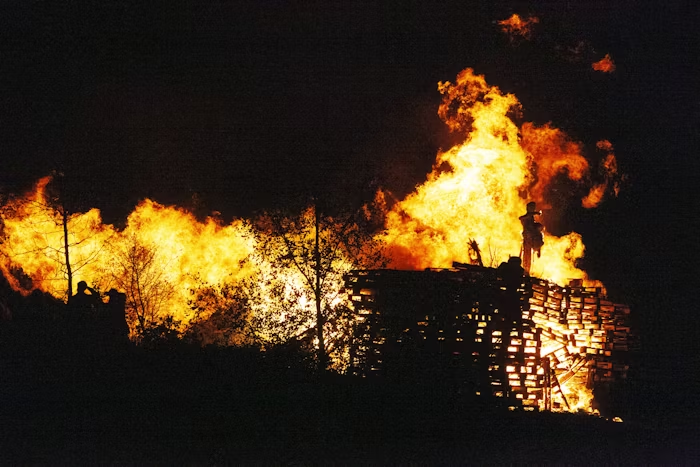
Fawkes became the ideal symbol – the recognisable face of the failed rebellion. His execution—being hung, drawn, and quartered—was a horrific object lesson, and the burning effigy was its annual, popular theatre.
So tonight, as the air crackles and the colours burst overhead, remember the chill in that subterranean vault, the glint of Guy Fawkes’ lantern, and the close call that defined a nation’s night of fire. We don’t just celebrate the light; we celebrate the absence of a world-shattering blast, making the whole affair feel wonderfully, spectacularly haunting.
The Wheel of Martyrdom – The Dark Origin of the Catherine Wheel
Just another little spooky tale for you before you leave to get your hats and gloves on, get your marshmallows ready and your own bonfires lit. Pay a thought to St Catherine and that spinning circle of light—the Catherine Wheel—which holds a history far more gruesome than the failed Gunpowder Plot itself, casting an ancient, holy shadow over our Bonfire Night celebrations.
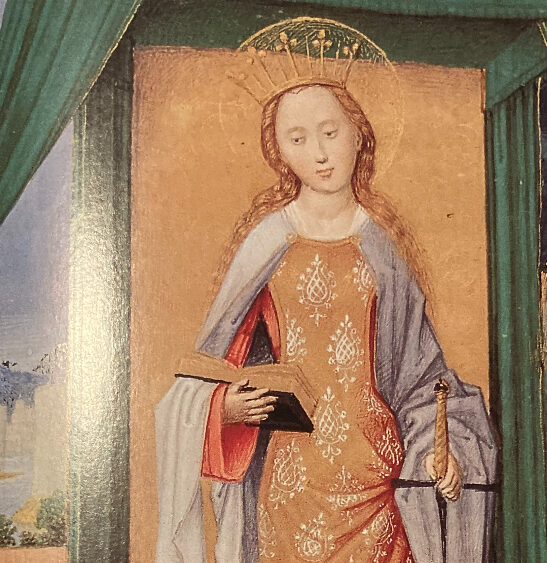
The firework is named not after a monarch or a conspirator, but after a Christian saint and martyr –St. Catherine of Alexandria.
According to legend, in the early 4th century, St. Catherine was a brilliant young noblewoman who bravely confronted the Roman Emperor Maxentius over his persecution of Christians. After successfully converting many of his philosophers and even the Empress, the furious Emperor condemned Catherine to a horrific death – breaking on the wheel.
This “breaking wheel,” or pinwheel, was a brutal instrument of torture where a victim’s limbs were tied to the spokes, and their bones were systematically shattered with iron clubs. It was a slow, agonising public execution.
The haunting twist in the story is that when St. Catherine touched the spiked wheel, it miraculously shattered into pieces, refusing to carry out her execution. The Emperor, undeterred, had her beheaded instead!
Catherine’s martyrdom on the symbolic, broken wheel made her the patron saint of all things related to spinning, including spinners, millers, and, eventually, the rotating firework.
The pyrotechnic device that spins and spews sparks, creating a circular effect, was named the Catherine Wheel as a direct, if somewhat macabre, homage to her famous, shattered instrument of death. Every time a Catherine Wheel is nailed to a post and begins its dazzling, fiery rotation, it is echoing the fate and miracle of a 4th-century martyr—a much older, stranger tale than that of Guy Fawkes and bonfire night itself!

Ultimately, Bonfire Night endures as a beautifully macabre spectacle because it binds together the historical terror of the Gunpowder Plot, the grisly legend of a saint’s wheel, and the primal urge to publicly burn an effigy—proving that sometimes, the darkest chapters of history make for the most dazzling and enduring celebrations!
Until next time dear friends x Easy to share with your friends too……..