Deep within the silent corridors of Thetford Forest, there is a church where the shadows of Scots pines stretch long over the flint-strewn earth, lies a building that shouldn’t be here. To the casual hiker, St. Mary’s at Santon Downham is a charming relic of medieval England. But look closer at its weathered stones, and you will find the scars of a violent, forgotten history.
The Church in the Forest and the Village of One
This is the “Church in the Forest,” but for centuries, it was known as the church of the moving sands. In 1668, a “Great Sand Flood” tore across the Brecklands, burying houses, choking the River Little Ouse, and threatening to swallow St. Mary’s whole. Today, a single, lonely brick high up on the tower remains as a silent high-sand mark of a tide of dust. This is a church that was nearly buried by sand.
But the sand is only the first of its secrets. From a “wolf” that defies nature to a lost chapel that exists only as a ghostly outline in the masonry, St. Mary’s is a place where history has been written, erased, and rewritten. And just across the river, its sister church—built for a village of exactly one person—holds a mystery of its own.
Step off the trail with me as we uncover the architectural “ghosts,” the royal pews, and the strange carvings of Santon’s ancient stones. Come with me on a walk near the ancient village of Santon and beyond.
A sand swept landscape that holds many ancient treasures (now in the British Museum, London)including the not far away Lakenheath hoard ( a significant find of Iron age silver work and Icenian (a tribe from eastern Britain during the Iron age)and The Mildenhall treasure (comprising of 32 masterpieces of Roman silver)both Lakenheath and Mildenhall in Suffolk both have a long history of archaeological finds. Both too are locations for United States Air Force Bases which have been here since the 1940’s and 1930’s respectively.

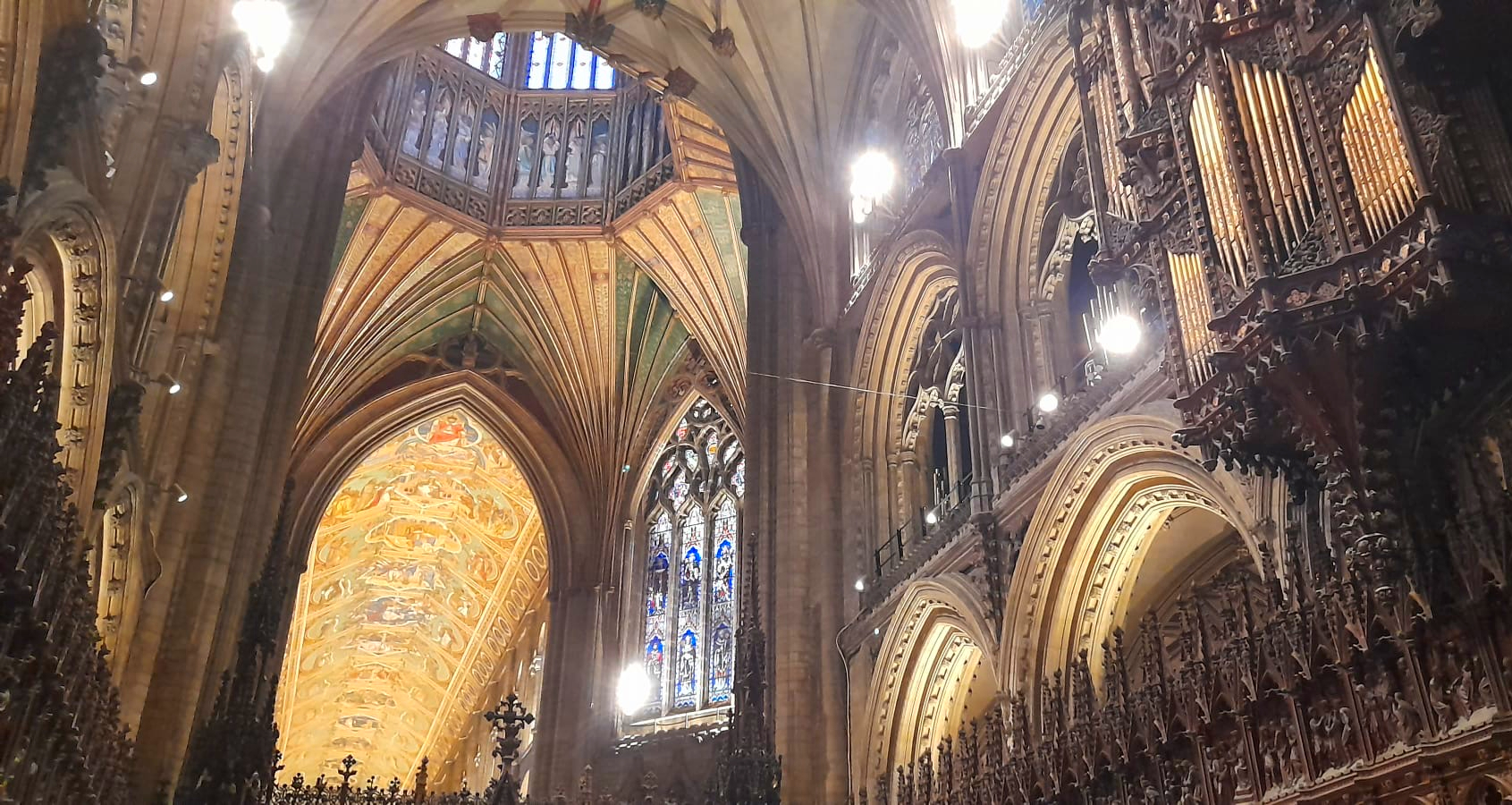
St. Mary’s holds a ‘wolf’ secret too – a similar contemporary design can be seen at Ely Cathedral (about 15 miles away) But this a Norman carved stone panel depicting a wolf or lion-like symbol – which seems to be devouring ‘the tree of life’ or a ‘vine’, which eventually seems to be sprouting from the wolf’s tail. A symbol of resurrection? or something more sinister? the wolf being a symbol for evil and destruction. See for yourself – It can be found above the side entrance door.

The Ghostly Walk: From the Sand-Swept to the Silent
To truly understand the secrets of Santon, you have to walk the mile between its two surviving churches. It is a path that takes you across county lines, over a hidden river, and through the “dead zone” of a vanished medieval village.
Step 1: The High Sand ‘Flood’ Marker (Suffolk)
Start at St. Mary’s in the late afternoon. Stand on the north side of the tower and look up at that single yellowish brick. Try to imagine the sky turning orange with dust as the Great Sand Flood of 1668 rose to that height. The silence here is heavy; it’s the silence of a building that was almost buried alive. Even today this sleepy little village is charming and spell-bound in its stillness. (easy parking here – a car park just across the road over the medieval bridge at the Forestry Commission car park which is central to exploration of the Little Ouse river – good for Wild Swimming too – and the Forest Walks).
Step 2: The River of Lost Bells
Follow the path toward the Little Ouse. As you cross the bridge into Norfolk, (just a few short steps!)listen to the water. Local legend says the bells of the ruined St. Helen’s were lost in these marshes centuries ago. On windy nights, hikers swear they hear a muffled, metallic tolling coming from the riverbed rather than the sky.
Step 3: The Grave of the Last Man (Norfolk)
Enter the churchyard of All Saints’ and find the moss-choked headstones of the Bancroft family. Standing here, you are standing on the ruins of a village that simply gave up. Thomas Bancroft rebuilt this church in 1628 when he was the only parishioner left, (see below details for Thomas Bancroft’s memorial stone set in the Nave floor at All Saint’s). The graveyard is “heaving”—the ground is uneven not from hills, but from the centuries of unmarked burials and the rubble of the grander church that once stood here.
Step 4: The Whistling Grille
Before you leave, find the iron grilles at the base of the flint walls. This is the site of the “Santon Dare.” Legend says that if you whistle into the dark void of the crypt at midnight, something—or someone—whistles back. As the wind kicks up through the surrounding pines of Thetford Forest, you might find yourself walking just a little bit faster back to your car.
That’s 3 churches – all that would have been less than a mile between them. Now you might get confused as to too many names for the same place here; St. Helen’s ( or Helena – who was the mother of the Roman Emperor, Constantine the Great)- let me tell you – St. Mary’s church (with the high sand mark, which tells the story of the water from the river overflowing and making the sand rise up the church this far, almost engulfing it)is in Santon Downham, West Suffolk. Then All Saint’s church which is in Santon, Norfolk, less than a mile away.
Nestled right on the border lies the ancient village of Santon, a place once home to the lost church of St. Helen’s. While all physical traces of the building have vanished, its legacy lingers in the names of the local well, the car park, and the nearby Forestry Commission site. Historical records suggest the church stood at or near the current site of All Saints, but local intrigue focuses on a mysterious ‘mound.’ Whether this feature is an ancient earthwork or a medieval moat remains unclear, but some believe it may have been the true site of St. Helen’s, as moated churches were a rare but real phenomenon in centuries past.
Lacking hard evidence this medieval church could well have been on the site of the present All Saint’s church (one of the smallest in England)and they say one of the most haunted, some people have also claimed a detectable smell of strong alcohol when entering the church… I did not notice this when I visited, however there was a smell of something strong which I failed to recognise what it actually was.

The present day All Saint’s has probable evidence to suggest it is in fact the site for the original medieval church, by the 16th century it lay demolished, and the land given to the Crown (Elizabeth ll). It was reconstructed and reconsecrated on January 6th, 1628. These repairs were carried out by Thomas Bancroft, a Remembrancer (An officer responsible for collecting debts that were due to the crown)he was also an English politician and a Member of Parliament for Castle Rising, Norfolk (nice Castle here, I’m due to do a post about this soon, so keep an eye out). This must have cost him a great deal of money but it must too have been meaningful to him to have done so,and he was the last man standing in Santon when he died being the only villager living there then!

Thomas died in 1636 and his tomb stone on the floor of the church is now beyond readable, but for those wishing to see the translation which is in Latin. Look here
The church feels eerie today with one of the coldest days for exploring, a smattering of snow lay around and the wind is strong and chilly.
There are just a few houses dotted around locally and the only real company is the occasional train whipping by or the whispers of the pine trees. The church was declared redundant yet again some years ago and a trust set up to care for it in 1996. I think Thomas would have been pleased so the spooky feel when wandering around surely can’t be him?!


St Helen’s 5 Mile Circular Walk
This lovely walk will take you through the forest and across the Little Ouse River. There are eight information boards throughout the walk which will give information about the history and wildlife of this area. The walk can be started from St. Helen’s Picnic Site (parking here is free, toilets are permanently closed) or Santon Downham, as above.
This is a circular walk with the Red trail being easy access and 1.5 miles long, (walking past All Saints church), the Orange trail at 5 miles circular or you could do the Brandon to Thetford Blue trail at 10 miles. Lots of information boards are all around here. More here
There is another ancient site here which can be accessed in the 5 mile circular route and that gets you to‘Blood Hill’ which is near Brandon, this lovely easy walk through wooded areas is known for it’s connections to prehistoric activity. Here is a significant Bronze Age burial mound (barrow). Prehistoric worked flints suggest long-term use and its name may be associated with ancient beliefs about battles. The site measures 29 metres and then rising to a height of half a metre,likely erosion has caused it to be somewhat smaller than originally- a funerary monument which may be some 4,000 years old.
Originally built as earthen mounds covering single or multiple burials, Blood Hill would have been surrounded once by a ditch, which now has been filled in.
Lots of prehistoric finds have been found here at Blood Hill, for example flint arrowheads, and blades and an axe head as well as something that resembled a dagger.

St. Helen’s Well is also to be found along this route, mind you, you have look out for it – like a lot of earth-based features, they tend to be overgrown or hard to still see. Formally known as a Holy Well, this natural spring comes from the bottom of a chalk pit, the water being collected in a basin on the chalk floor and then flows southwards towards the river in a channel. Prone to degradation and mining these Wells were once important parts to a pilgrimage taken by people in both medieval and Pre-Christain times but many now lost. A short clammer down a grassy path will give you a decent view of the water and sides of what once was a quarry (for chalk).
St Helen is associated with safe Travel and Water – water from her Well may have been used for protection, cures, magic or even spells. While you’re here, why not conjure up a bit of sorcery yourself, just remember to use it for some good!
The church in the forest may be your place to contemplate, wishing every traveller all the best …..
Just before I go – Why not visit (it is just a few miles away) Grimes Graves (A pre-historic Flint Mine) More Here
Until next time dear friends x