Let’s journey back thousands of years and find out how people in the Neolithic period travelled.
Travelling in Neolithic times
I’ve always been drawn to the stories of nomads and travellers searching for the next horizon. Imagine a time before agriculture, when safety, food, and community couldn’t be found in one fixed place. To survive, you had to keep moving.

People would have to travel from place to place looking for these everyday requirements. Today we can choose to camp out then go back to our comfortable beds but back then there was no choice until farming, tools, money exchange and working all this out into community living became a thing.
The Neolithic period, also known as the New Stone Age, marks a significant turning point in human history in the UK, transitioning from a hunter-gatherer lifestyle to one based on agriculture and settled communities. This era roughly spans from around 4000 BCE to 2500 BCE.
Key Characteristics of the Neolithic Period in the UK and How People Travelled
- The Adoption of Agriculture – This is the defining feature. People began to cultivate crops (like wheat and barley) and domesticate animals (such as cattle, sheep, and pigs). This led to a more sedentary lifestyle as communities became tied to their land.
- The Rise of Settled Communities– While not entirely static, settlements became more permanent. Evidence of houses, often rectangular longhouses made of timber and wattle-and-daub, has been found.
- The Development of Pottery – The creation of fired clay pots allowed for cooking, storage, and transportation of liquids and food in new ways.
- The Construction of Monumental Architecture – This period saw the construction of impressive structures like causewayed enclosures (early gathering places), long barrows (burial mounds), and later, the iconic stone circles like Stonehenge and Avebury. These monuments likely served social, ritual, and possibly astronomical purposes.
- The Use of Polished Stone Tools – While stone tools were used in earlier periods, the Neolithic saw the development of more refined techniques, particularly polishing, which created stronger and sharper axes and other implements crucial for farming and woodworking.
- Early Forms of Trade and Exchange – Evidence suggests that certain materials, like flint for tools and specific types of stone for axes, were exchanged between different communities, indicating some level of interaction and travel.
How Did Neolithic People Travel Around the UK?
Travel during the Neolithic period was undoubtedly challenging and time-consuming compared to modern transportation. However, people were not isolated, and various forms of movement and connection existed:
- Foot Travel – This would have been the most common method. People would have walked along natural routes, animal trails, and potentially early trackways that may have developed over time. The landscape, with its forests, rivers, and hills, would have significantly influenced the paths taken.
- Water Travel – The UK is an island nation with numerous rivers and coastlines. Evidence suggests that boats, likely simple dugout canoes or hide-covered frames, were used for travel along waterways and potentially short sea journeys. This would have been particularly important for accessing resources, connecting coastal communities, and possibly for trade. The discovery of Neolithic axes made of stone from the Scottish Highlands in southern England, for example, hints at longer-distance travel, possibly involving coastal routes.
- Animal Transport (Later in the Period) – While the initial domestication of animals was primarily for food, it’s plausible that towards the later part of the Neolithic period, larger domesticated animals like cattle may have been used to carry loads, although direct archaeological evidence for this in the early Neolithic is limited. The development of more complex agricultural practices might have coincided with the early use of animals for transport.
- Following Resources – Hunter-gatherer elements likely persisted to some extent in the early Neolithic, and people would have moved to access seasonal resources, even as agriculture became more central to their lives. This could have involved short to medium-distance movements.
- Social and Ritual Journeys – The construction and use of monumental sites like Stonehenge and Avebury suggest that people travelled to these locations; possibly for ceremonies, gatherings, or to participate in communal activities. These journeys could have involved significant distances and may have been undertaken by large groups.
- Trade and Exchange Networks – The movement of raw materials like flint and stone indicates the existence of trade or exchange networks. While individuals might have travelled to acquire these materials directly, it’s also possible that goods were passed along between different groups over distances.
Read our Chronicles (blog) on best ways to CAMP in the UK
Challenges of Neolithic Travel
- Terrain – The UK’s landscape was heavily forested in many areas, with marshlands, rivers, and hilly regions presenting significant obstacles.In my other blog posts I talk about the ancient roads of the UK, you might like to read.
- Lack of Roads – Formal road networks did not exist. Travel relied on natural paths and any rudimentary tracks that may have developed through repeated use.
- Carrying Capacity – Moving goods and belongings would have been physically demanding, limiting the amount that could be transported.
- Navigation – Without sophisticated navigational tools, people would have relied on landmarks, natural features, and possibly a developing understanding of the stars for orientation.This took time to learn and older people in communities or ‘wise ones’ would have been very important.
- Safety – Encounters with wild animals, and potentially other groups could have posed risks to travellers.

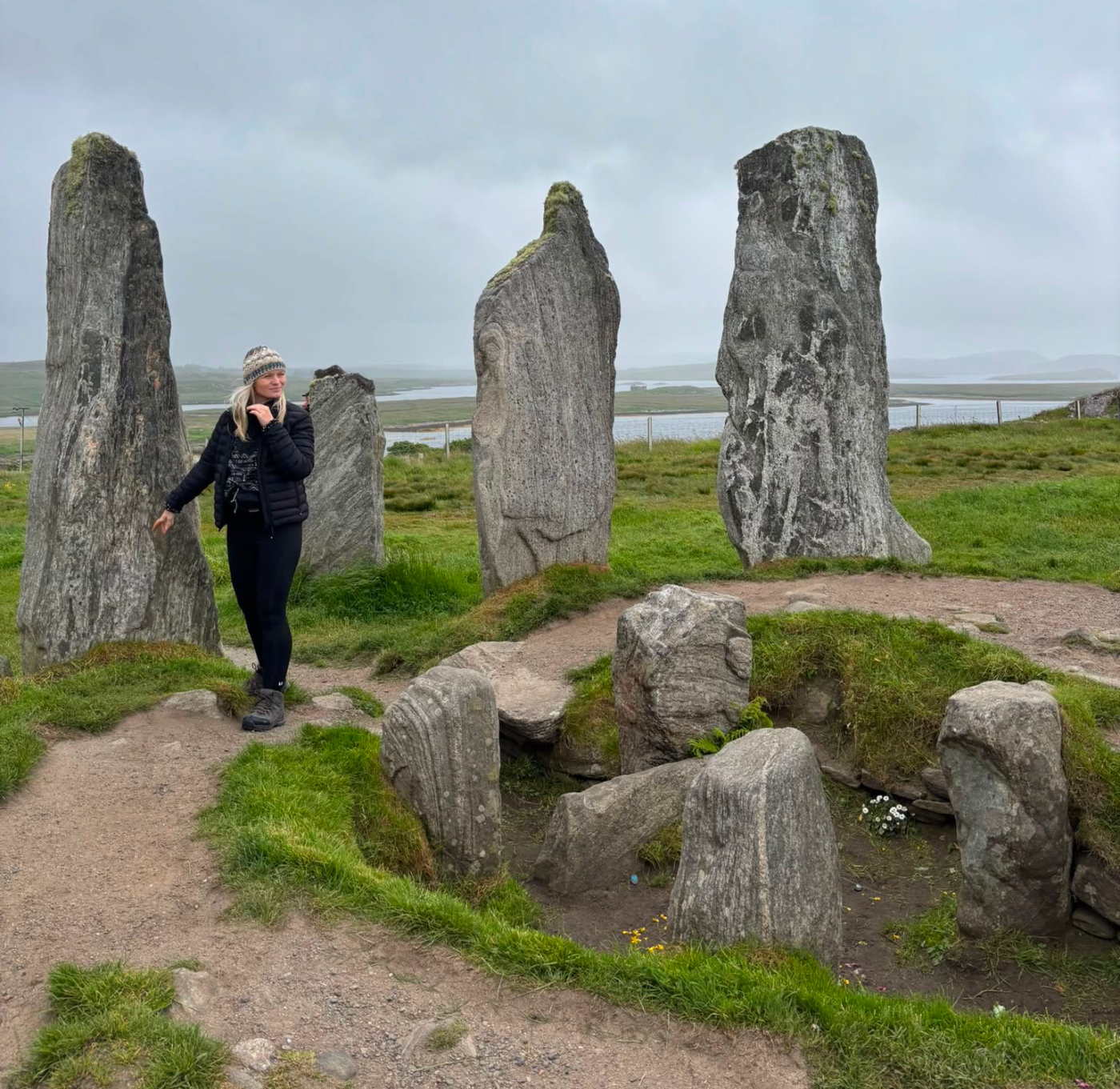
Want to know more about the Calanais Stones? Tap just here
Journey in the path of the Neolithic People
While Neolithic people in the UK did not have modern means of transport, they were certainly mobile. Foot travel and water travel were the primary modes of movement, facilitating access to resources, social interaction, and the exchange of goods and ideas across the landscape. The construction of monumental sites also implies significant journeys and the ability to organise and undertake large-scale movements of people. The Neolithic period laid the foundations for later developments in travel and communication in Britain and we are fortunate to still be able to walk their ancient routes and visit their burial and ceremonial sites.
It’s been estimated that the average person will move house up to 8 times in their lifetime in the UK; It seems we still have roaming in our blood.
Visiting these Neolithic sites offers a unique opportunity to connect with the deep history of the United Kingdom, marvel at the achievements of prehistoric people, and to ponder the mysteries of their beliefs and way of life. Each site has its own distinct character and offers a different perspective on this fascinating period of human history.
So by exploring or camping near these ancient landscapes, you are not just a tourist but a time traveller, tracing the very footsteps of our ancestors.

These sites are not merely stone circles and burial mounds; they are echoes of a vibrant and dynamic past, reminding us that the human story is one of constant movement, curiosity, and the enduring quest to leave a mark upon the world.
By walking in the path of the Neolithic people, we can better understand not only where we have come from, but also the fundamental human desires that continue to shape our journey today.
Just visiting these Neolithic sites offers a unique opportunity to connect with the deep history of the United Kingdom, marvelling at the achievements of prehistoric people and pondering the mysteries of their beliefs.
So, the next time you pitch a tent or hike through the British countryside, remember that you are not just a tourist—you are a time traveller, tracing the literal footsteps of our ancestors. We aren’t just looking at cold stone and earth; we are witnessing the very dawn of community, trade, and travel in Britain. Wanderlust, it seems, has been flowing through our veins for thousands of years.
These ancient landscapes are echoes of a vibrant, dynamic past, reminding us that the human story has always been one of movement, curiosity, and the enduring quest to leave a mark upon the world. By walking the paths of the Neolithic people, we connect with the fundamental desires that continue to shape our own journeys today. So pack your bags, lace up your boots, and go find the echoes of the past.
Until next time dear friends x