The Nightingale Connection
On a recent TV binge of Agatha Christie movies, I came across a film entitled, ‘The Truth of Murder’ written by Tom Dalton as an alternative history drama (speculative fiction). It got me to thinking about all the thrill it is to step on a steam train and chug across the windswept moors of Yorkshire or the green lands of Ireland. But this is a murder story so maybe not so nice, but a good watch nonetheless.
This TV drama was a story about how the famous 11 day disappearance of Agatha Christie (this bit is true)and how she solved the murder of a Florence Nightingale Shore (the murder of Ms. Shore is true)in the time she had been missing, the 11 days – something the police could not do.

It got me too to thinking about the original Florence Nightingale (the famous nursing pioneer, born 1820-1910)and all the work she did in the war (WW1) not least the country houses she must have visited in England while socialising with family and friends.
She was ‘well connected’, her father was a wealthy landowner and her upbringing was defined by this elite social standing. She was well educated by her father who gave her a well-rounded knowledge of the world and mixed with society who had great wealth. She would have seen many of our grand houses in all their opulence as well as in the days when they were starting to be too much for their owners to upkeep.

Hundreds of country houses like Cholmondeley Castle, Leeds Castle, Hatfield House, and Herewood House served as a means to free up city hospitals during the war and thought ideal places for the fresh air for any of the soldiers with respiratory illnesses. After the war many of these houses were returned to their owners, in some cases in such a bad state of repair they were either demolished or sold.

Now lets get back to that TV drama –
Florence Nightingale Shore was named after her Godmother – Florence Nightingale . Florence Nightingale Shore came from a well-to-do family too and her parent’s wish for their new baby daughter to be named after someone they knew well and respected fulfilled their desire for happiness.
A Cold Case on the Rails
Ms.Shore was born in 1865 and led a life of relative luxury, she had no real need of employment but because of her need to be of use and satisfy her humanitarian needs she followed her famous Godmother and worked as a nurse after qualifying for a certificate from the Royal School of Nursing in Edinburgh, Scotland. Working in military environments at home as well as abroad, she was also a qualified midwife.
By 1920, Florence was living a bustling life in Hammersmith. That year, she set off by rail for Hastings to visit friends. Her friend, Mabel Rogers, saw her off, but later recalled a ‘clean-shaven, young gentleman’ boarding the very same carriage. He had been seen chatting with two women on the platform before waving them goodbye—a seemingly innocent encounter that would become a vital piece of a chilling puzzle.
It was just a few hours later that Ms. Rogers was summoned to Florence’ s bedside in hospital, she had been found by a group of people entering the train who saw she had been badly beaten about the head. Florence was in a coma, which lasted three days, she died without waking again.
A police investigation was underway but evidence was slim and no-one could identify the young man Mabel Rogers saw entering the train. She remembered his face well but the only man to be presented to her for identification did not match her memory of the well-groomed chap. No one was seen leaving the train at Polegate, where the group who discovered Florence’s body entered, it was thought he must have left the train at the earlier stop at Lewes. The killer was never caught.

The police concluded the crime was about robbery as money and jewellery had been missing from Florence’s person. Florence was never married, and it is said she is the richest person to have ever been murdered on a train!
The Romance of the Iron Giant
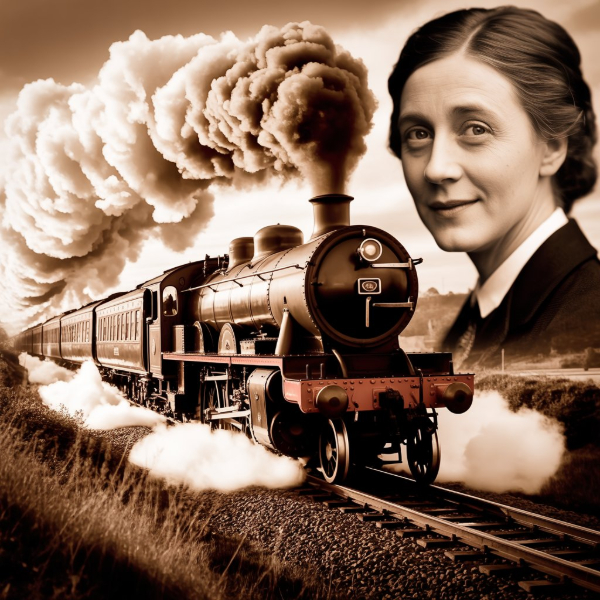
Just like the legendary train in Christie’s Murder on the Orient Express, (1942) this was a hulking, noisy steam engine. It was a magnificent, trundling giant that filled passengers with a sense of dread and wonder as it came roaring through those beautiful, colourful and sometimes architecturally magnificent station stops.
Stations we can still see today, and the UK has many beauties still left over from yester-year. Big masterpieces like King’s Cross, Paddington, Liverpool Street and St. Pancras– if you look up you’ll see fabulous architecture, even small local stations offer the eagle-eyed a chance to see some fabulous craftsmanship in the way of elaborate carpentry, ornate brick work and fancy paint, tiles or gilding work. A lot of these have now been lost as well as the tracks however lots have been reinvented with cycle ways, foot paths and highways.And restoration is popular amongst enthusiasts and bringing back these little time capsules can transport us straight back to 100 years ago.
Most London stations appeared in the 19th century during the rail transport boom and a lot of money and pride were put into their build and presentation. Distinctive Gothic architecture as in the building of St. Pancras railway station was a real hit with the public and the enormous, decorative, iron girders looking almost cathedral-like must have inspired people to take a train journey whenever they could.

This is something you can do today and lots of independently run stations offer steam train rides, journeys and experience days or even weekends and I have found some of the best around the UK so you can just imagine the days of Agatha Christie getting the train from here to there and imagining her own stories of murder and intrigue to share with you even today.
5 Journeys and Haunts along the Railways – Are you looking for a heart pounding adventure?
Journey along the Worth Valley in a steam train scare of your life. Your train journey at Halloween will take you through eerie landscapes and desolate rail tracks, you will encounter ghosts, ghouls, witches and more. Are you brave enough to board The Scare Train? Visit this unique 5 mile branch line set in industrial North Yorkshire and experience the old steam and some diesel trains at their best.
There is also an All Age train adventure which runs 29th, 30th and 31st October departing from Oxenhope, on the Keighley & Worth Valley Railway line …………………….
- The Keighley & Worth Valley Railway: Experience the “Scare Train” through the eerie landscapes of industrial North Yorkshire. Perfect for those who want to encounter witches and ghouls along a 5-mile branch line. HERE
- North Norfolk Railway: Travel from Sheringham to Holt on a calendar filled with history and mystery. Here
- North Yorkshire Moors Railway: Join Mad Alice’s Ghost Train. This interactive storytelling journey from Pickering to Levisham takes you across windswept moors. (Note: Check for 2026 availability due to restoration works). Here
- Waterford & Suir Valley Railway: A slightly less spooky, family-friendly adventure in Ireland for those who prefer heritage over haunts. Here
- The Dava Way, Scotland: For the hikers! A “Ghost Train Walk” along a vanished track that promises an atmospheric amble through the Highlands. Here
Until next time, dear friends… keep one eye on the platform and the other on your cabin door. x