It’s early morning, I’ve driven 5 hours to see this ancient site and it’s exceeded all my expectations in unearthing treasures of the past.

The mist is rolling over the hills and land and this has created an atmosphere at Lady’s Well, (an ancient Holy Well) in Holystone, Cragside, which is almost hypnotic.

I was entranced by the beauty and peacefulness of the place and glad I came all this way. This place is now when I am in Northumberland, one of my favourite haunts. The feeling of being watched by the ancients is all around me.
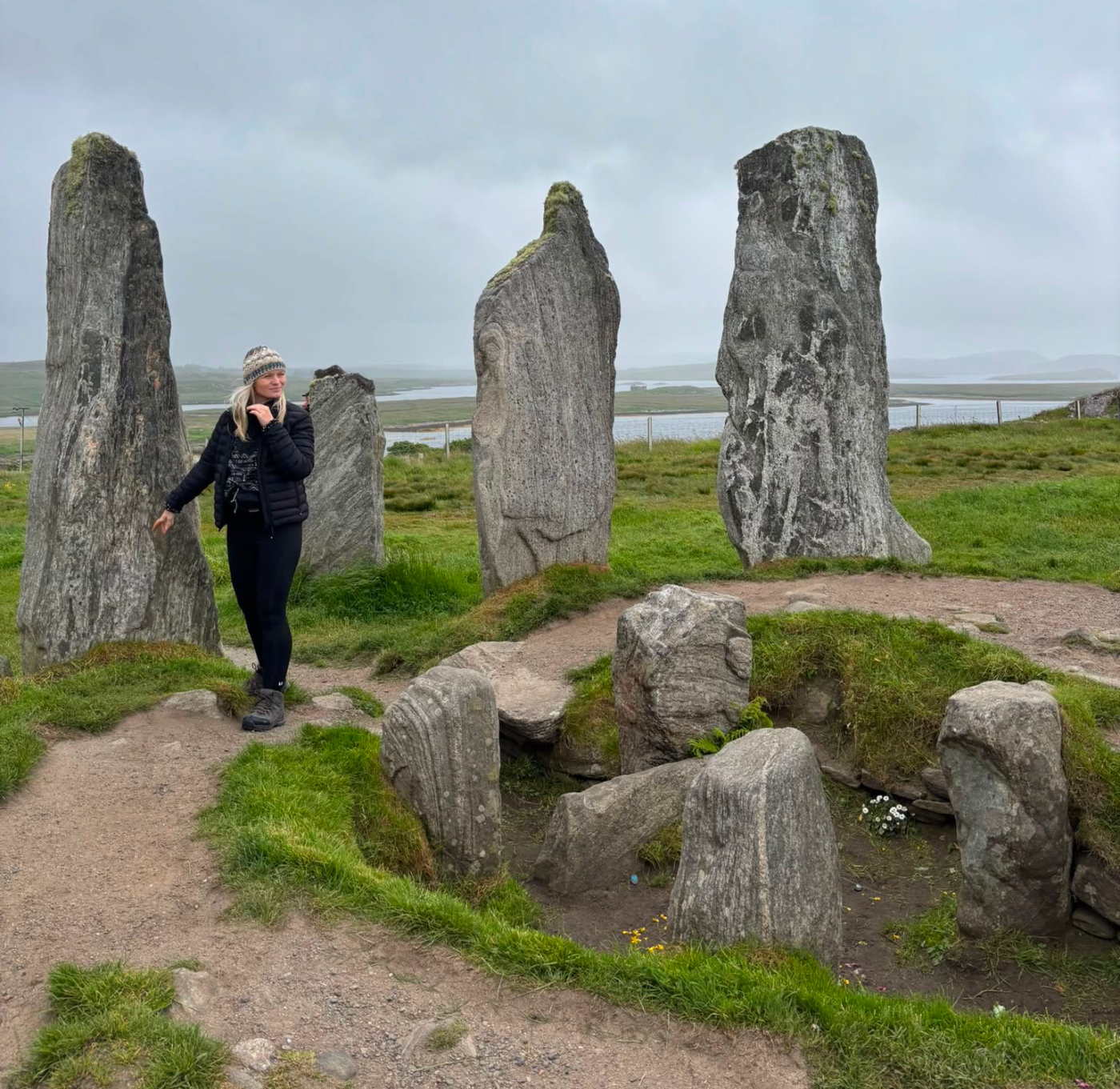
This mystical, magical, timeless place revered by pilgrims for millennia was truly atmospheric, as I pull my brightly coloured woolly hat closer around my ears, the mist conjuring up thoughts of people over the time using the natural spring for survival, and then worship, you can almost hear the footsteps, gentle laughter or quiet wailing.

If you have a car – There is no clear parking but you will be able to find a place at the side of the road near a group of houses here, the people here were very friendly and chatty today.

Walking the haunted history of the UK
On the borders of Scotland and England, Lady’s Well stole my heart. I really did not want to leave but I gathered myself after much contemplation, and started off for Harbottle Castle; which is a gentle few miles away, then onto The Drake Stone, (or The Dragon Stone) (said to have healing powers) another truly mystical place, surrounded by scenery that blows your mind. A place where Stone Age people would have stood where I stand now.
Want to know more? Do you like Walking? – The Drake Stone and the Harbottle Walk
The UK isn’t just a collection of historical sites; it’s a living, breathing tapestry woven with tales of triumph, tragedy, and the lingering presence of those who came before. It’s a place where history isn’t just read in books, but felt in the very air.
This post will explore the fascinating duality of the UK – its rich, often eerie, haunted history, and the incredible treasures that tell the story of its past.

The magic of Glen Coe, Scotland
Content
- Distant Magic – A Haunted UK
- Key UK Haunts
- Echoes of Grandeur- Treasures of the Past
- Roman Legacy – Anglo-Saxon Riches
- Medieval Splendour
- Industrial Revolution Innovation
- A Journey Through Time and Spirit
A Haunted UK -Distant Magic
Layers of earth and history; dramatic events, ancient landscapes, the UK has it all. And, ghost stories, they too, are part of the cultural fabric.
Everyone loves a ghost story, I remember when I was a kid, ghost stories around the campfire even with adults present would frighten me as much as delight me. Still, I am Intrigued as much today as when sharing burned marshmallows with my family all those years ago.

Ghost Stories
The UK is famous for those all too known stories about Kings and Queens, haunted castles, and buildings, and eerie tales of the unrested! ( unrested – this word is now obsolete – I don’t use it very often, it just felt right here. The Oxford English Dictionary states “It is only recorded in the Middle English Period 1150-1500. And their only reference for it was before 1475) I love that!
The United Kingdom has a rich and diverse history, and its “treasures of the past” encompass a vast array of archaeological finds, historical documents, and iconic structures. These treasures offer us insights into the lives, cultures, and events that have shaped the nation over millennia.
The power of these artifacts lies in their tangible connection to the past, offering insights and stories that words alone often cannot convey.
They are silent witnesses, physical remnants that have endured the passage of time, allowing us to bridge the gap between our present and the lives of those who came before us. The unrested still telling their tales.
Holding an ancient tool, touching a piece of Roman pottery, or standing before a medieval castle creates a direct, visceral link to the past. It’s no longer a page from a book; it’s something real that someone else, centuries or millennia ago, also held, used, or built. This really sparks our imagination and curiosity like nothing else.
Artefacts or treasures as I call them, often show the marks of human hands – tool marks, wear and tear, repairs.
Witches Marks on houses in the UK – “Have you noticed the Witches mark here near the front door?” the lady trying to sell me the house said rather nonchalantly. No, I said rather surprised I hadn’t; as I am always on the lookout for that sort of thing.
These protection marks are often found in churches and are totally fascinating.
Want to know More? Witches Marks
These ‘treasures’ allow us to connect with the individual who created or used the object, fostering a sense of empathy and understanding for their daily lives, struggles, and triumphs. A child’s worn shoe from a Tudor site, for example, speaks volumes about childhood in that era, conjuring up emotions that simply reading about it will not.
I keep and occasionally use a cookbook – it’s just a simple one, entitled, Recipes from the Farmhouse Kitchen that my grandmother used to use. It was somehow kept in the family, I say that because neither my mother or myself were particular to a recipe, moreover just chucking it all together and hoping for the best was/is normal.
But this little book now a bit torn, and yellowing, has ‘dog ears’ to mark pages, wiped gravy spills, and highlighted text.
This gives me a feeling of connection, just the smell of the little book evokes in me the power to journey back to a time I did not know, a time where ingredients like sugar, flour and butter might have been hard to come by or even precious, ingredients maybe saved for a special occasion. All of my senses are transported back more than half a century with just a flick through an old cookery book! A time after World War ll, rationing, making-do, resilience, innovation and strength.
Treasures are more than just old objects; they are conduits of human experience. They allow us to move beyond abstract facts and dates, providing a tangible, emotional, and often deeply personal connection to the people, cultures, and events that have shaped our world. They tell stories of ingenuity, resilience, daily life, belief systems, and the enduring human spirit in ways that words, however eloquent, sometimes cannot fully capture.
I think they call it, “presence without proximity”. It is the magic that allows us to feel a deep connection to something that is, by definition, distant.
Connecting with the past can be “haunting” in a profoundly memorable and even pleasurable way, rather than a scary one.

The Tower of London is said to have many ghosts
This kind of haunting is less about ghosts and more about a deep, often evocative presence of what has been. It’s about feeling the echoes of lives lived, sensing the passage of time.
Just here I have listed a selection of well known and some not so well known UK treasures you might like to visit and the stories behind them.
Key UK Haunts –
The Tower of London – Anne Boleyn, the Princes in the Tower, many other spectres are said to haunt the Tower of London, there are said to be 13 ghosts that haunt the Tower and there is even a Ghostly Bear that refuses to leave. (did you know King John started a zoo here and it was kept by many other succeeding Kings?) The Tower Of London is London’s most popular destinations for tourists, I think the appeal is easy to work out
Edinburgh – The Vaults – A look into Edinburgh’s past; I found the Vaults (underground chambers beneath the old town) very creepy; just imagine you are standing where people would have lived, conducted their business or been part of criminal gangs- it all went on down here! The dark, hidden side of this city, stories of plague victims, and poltergeists all haunt Edinburgh. Edinburgh is famous for so many things, Edinburgh Castle, Mary Queen Of Scots, Arthur’s Seat (an ancient extinct volcano), The Palace Of Holyrood House (the official Palace of the British Monarchy) and of course Whiskey!
Pluckley, Kent (England’s Most Haunted Village)– A concentrated area of various apparitions, from the “Screaming Man” to the “Red Lady.” It’s not just a few places in this village but the whole village seems to have a reputation of being the most haunted village in England. In the village a lot of the houses have narrow, round-arched windows, framed by white painted brick; these windows are known as ‘lucky’ Dering windows. According to legend A royalist member of the local Dering family escaped through such a window while being pursued by parliamentarians during the civil war. Today an ancestor of the lucky Dering chap hangs about in the local churchyard as The Red Lady, still looking for her child from hundreds of years ago. Other ghosts include the pipe-smoking gypsy who burned herself to death; she can be seen wandering around the village still.
Blickling Hall, Norfolk –Anne Boleyn again, and a grand stately home with a recurring spectral presence. The tragedy of Anne Boleyn can not easily be forgotten and still we sympathise with her today. Blickling Hall once belonged to the Boleyn family and there are some who suggest Anne was born here. There is a statue of Anne to be found at Blickling Hall for you to see but the house we see today would have been built on the Old Hall and grounds, of which the Bullen’s (the medieval spelling of the surname has been found to be spelt differently in lots of documents) knew.
Pendle Hill, Lancashire – The witch trials here and the lingering sense of unease, and injustice connected to this historical landscape leave you with a real sense of perhaps this was a ‘warring neighbours thing’ that just got out of hand.
Pendle Hill in the East of Lancaster is notorious for its 17th century witch trials which saw Jennet, a 9 year old child give evidence against her mother, brother and sister. On the 400th anniversary of this awful event there were art displays and music played in order to remember this tragic event. Walking the Pendle Way – all the way to the Castle, at about 48 miles it’s hard going today – let alone being marched there likely tied with rope, cold, hungry, frightened and confused. This would have been the route taken by the prisoners to their trial and execution. You can’t help but shed a tear.
“My mother is a witch and that I know to be true. I have seen her spirit in the likeness of a brown dog, which she calls Ball. The dog did ask what she would have him do, and she answered that she would have him help her to kill.”

Pendle Hill, Lancashire, from the West – covered in mist
Treasures of the Past
Treasures (this can be glittering gold torques from the Celtic Period to the ancient powers of mythical sites like Stonehenge) these treasures offer a concrete link to the past, often unearthed from the same ground that holds ghostly whispers.
Here we will look at just a few examples, as the UK just keeps giving us incredible discoveries that constantly rewrite and enrich our understanding of its vibrant and complex past.
The “treasures” are not just the precious metals or grand structures, but also the everyday objects, the footprints, and the written records that connect us to the people who came before us.
Lets travel back in time through the centuries and have a peep into some of the treasures the UK has to offer and not forgetting Archaeological discoveries from beneath landscapes, and ongoing excavations in cities like London continue to uncover layers of history, revealing Roman, Anglo-Saxon, and medieval settlements, often providing new ideas on daily life and major events.
We’ll start with Prehistoric Wonders
- Stonehenge and Avebury – Not just stones, but monuments built with incredible effort and mystery. Their spiritual significance still holds mysteries for us today. We can see the stones, we have an idea what they looked like but still unfolding reasons for them today. Why were they so important to our ancestors and why is it that the echoes of the past can still be felt today?
- Glastonbury Tor/Chalice Well -These mythical sites, often associated with Arthurian legends and early Christianity hold a sense of ancient power.
Then the Roman Legacy
- Hadrian’s Wall – A frontier of an empire, and a testament to engineering and control. This huge wall, more than 70 miles long, was built in about 122 AD and marked the Northern boundary coast to coast to guard Roman territory. You can still walk the wall – Want to know more? Hadrian’s Wall
- Roman Baths (Bath) – A sophisticated leisure complex, showing the advanced nature of Roman life. There is no bathing in the Roman Bath sites but it offers a wonderful tour. The City itself is called after the Baths. The Romans called this city Aquae Sulis or Waters of Sulis after a Celtic Goddess associated with healing and protection. Later the Anglo Saxons referred to it as Badum meaning ‘at the baths’ , then later being referred to as Bath. Want to know More? The Roman Baths

The Gilt Bronze Head of Sulis Minerva
- Roman Coin Hoards – Numerous hoards have been discovered, such as the Seaton Down Hoard (22,888 coins), which provide valuable information about the economy and political landscape of Roman Britain. You can see these spectacular treasures for yourself by visiting many of the marvellous museums around the country. Museums will often share or loan their treasures across the country. Here are3 famous hoard treasures to see–
- The Seaton Down Hoard – Its permanent home is at the Royal Albert Memorial Museum in Exeter. Want to Know More? Here
- The Chew Valley Hoard – Its permanent home is at the museum of Somerset Want to Know More? The Chew Valley Hoard
- The Staffordshire Hoard – Its permanent display is in the Stoke-On- Trent Museums. The largest find of Anglo Saxon gold and silver metalware ever found! Want to Know More? The Staffordshire Hoard
And Anglo-Saxon Riches
- Sutton Hoo Hoard – The sheer beauty and historical significance of this ship burial, is thought to have belonged to Raedwald King of East Anglia. In a time before ‘England’ existed it is thought this great ship and all its treasures would have given this Anglo Saxon King a ‘send off’ that was fit for a King! Early ship burials were rare in Anglo Saxon times and this one possibly points to the power he may have held over surrounding kingdoms.

Anglo-Saxon Sword Belt end, studded with sparkling jewels
Not forgetting Medieval Splendour
- Crown Jewels (Tower of London) A tangible link to centuries of monarchy, power, and tradition.The Crown Jewels are used for such occasions as Coronations, State Opening Parliament, and most recently crowning King Charles and Queen Camilla as regents. These magnificent crowns are all made of the real stuff, gold, gems, and semi- precious stones. But the magnificent St Edward’s Crown 1661 is only used for the crowning moment itself as used for Charles 111 in 2023.
In total there are 19 Crowns which are kept along with the Sceptre (used at every Coronation since 1661) and other regalia at the Jewel House under armed guard in the Tower of London.
Scotland has its own Crown Jewels in Edinburgh Castle referred to as The Honours of Scotland, so too have the Welsh with their own regalia; and the theft of the Irish Crown jewels in 1907 has never been solved.

The Crown of Scotland. Used to crown the monarchs of Scotland, and thought to have been made in the reign of Robert the Bruce (King of Scots from 1306-1329)
- The First Welsh Bible – Published in 1588, this Bible was instrumental in preserving the Welsh language. Bishop William Morgan was commissioned to produce a standard welsh addition in 1588, its held in the Westminster Abbey Collection.

- King Richard III’s Remains – The discovery of his skeleton in Leicester in 2012 finally solved a long-standing historical mystery and provided new insights into his life and death.

- Canterbury Cathedral/Westminster Abbey – Architectural masterpieces filled with history, art, and the tombs of historical figures.

Industrial Revolution Innovations
- Iron Bridge Gorge – Birthplace of the Industrial Revolution, a testament to human ingenuity and the changing landscape.
- The Very Poor – I’m talking Workhouses – places where the very needy could get a roof over their head and a crust of bread as a meal in the Victorian days.and before. London alone had about about 80 Workhouses in 1776.
Wales A visit to a Workhouse – worth a visit
A Journey Through Time and Spirit
Ongoing excavations in cities like London continue to uncover layers of history, revealing Roman, Anglo-Saxon, and medieval settlements, often providing new perspectives on daily life and major events.
These are just a few examples, as the UK continues to yield incredible discoveries that constantly rewrite and enrich our understanding of its vibrant and complex past. The “treasures” are not just the precious metals or grand structures, but also the everyday objects, the footprints, and the written records that connect us to the people who came before us.
The ‘spirit’ of these places can be felt through its spectral residents and its tangible relics.
Often, the places that hold great historical treasures are also profoundly haunted (think the Tower of London). The stories behind the treasures are often filled with the human drama that creates haunting’s(the violence surrounding some Crown Jewels for example, some stories for another blog post).

About 2 miles from the Tower of London stood Whitehall Palace, where in 1649 the execution of Charles I took place.
Visiting these places is not just to see the ghosts or the gold, but to feel the weight of history. To consider the lives lived and the stories left behind.

The UK is full of magic and mystery, a place to be open to the unseen and cherish our tangible links to the past. The UK is a place where the past isn’t merely history, but a living presence, waiting to be discovered, a whisper or a treasure at a time.
What is it about these places that so deeply captivates us? Is it the thrill of the unknown? The whispers of untold stories? Or is it simply a profound connection to the past, a tangible link to the lives that came before us? For me, it’s all of that and more. It’s the thrill of history reaching out and touching us, reminding us that while time moves relentlessly forward, some echoes simply refuse to fade.
So, next time you’re planning a trip to the UK, consider adding one of these hauntingly beautiful sites to your itinerary. Go with an open mind, a respectful heart, and perhaps, just perhaps, you’ll feel the presence of those who still linger, weaving their tales through the very air you breathe.