1300 years of history and the oldest wooden church in the world – a walk around
It is said Greensted Church in Essex is not only the oldest church in the world but is also the oldest wooden building standing in Europe. People have worshipped here for at least 1,300 years, making Greensted span almost the whole history of Christianity in England.
The Saxons likely settled here at Greensted in a convenient clearing within the vast woodland that was once here and consisted of the Epping and Hainault forests.
By approximately 650 AD, the first church may have been established—a simple structure of upright logs set into trenches and topped with a thatched roof. Archaeological excavations in the 1960s confirmed this early activity, uncovering the footprints of two wooden buildings beneath the current chancel floor, dating back to the late 6th or early 7th century.

A Walk Around the Extended Church at Greensted
Have a walk around Greensted with me and we can explore this wooden structure together – albeit with additions, which we will take a look at too.
Lets start outside – To the left of the porch entrance you will see the ‘Crusaders coffin’
It is thought to be the final resting place of a crusader. It is made of stone – so, material brought in specially for the job which indicates he was seen as a local hero, and believed to be a Bowman who had lived through one of the 12th century crusades.
Walking around this lovely little church on a cold but sunny day, I found a fascinating mixture of gravestones. The Crusader stone coffin being the oldest, but if you look past the medieval and modern plots, you can spot ‘mounds’—the likely remnants of graves lost to time.
The churchyard is now closed to burials. It has as you walk along and to the back a peaceful remembrance garden planted with roses and herbs ……….. Why not take a minute for quiet reflection or sit on the benches provided for a longer look at England’s oldest church.
Ready? As we move to the rear of the church, notice the huge oak logs split lengthwise—these comprise the building’s oldest section. This Saxon-era structure (c. 1060 AD) forms the current Nave walls. By comparison, the surrounding sections are relatively modern: the south brick chancel dates to 1500, and the west tower to the 17th century, it is clad in a white weatherboard which is common to this part of the Essex and topped with a shingle roof that resembles a witches hat! Now, follow the path to the porch, and we’ll head inside.

A Legacy in Oak: The Persistence of the Saxon Spirit
As soon as you’re inside your eye is drawn to the other side of the logs- which we have just seen outside, from inside they look a little different, instead of the rustic log-look, you’ll notice they have been smoothed for decoration purposes, giving it a nice finish but you can clearly make out these were once massive cut logs now finished with tongues of wood strips to fill the gaps.
Your eye is immediately drawn to the beam spanning the width of this small church, known as either the Communion beam or the St. Edmund’s beam. At its centre sits a beautifully carved wooden acorn boss. The building we see today was in a sorry state during the Victorian era until the Rector Philip Ray began an extensive restoration (some say an over zealous act).
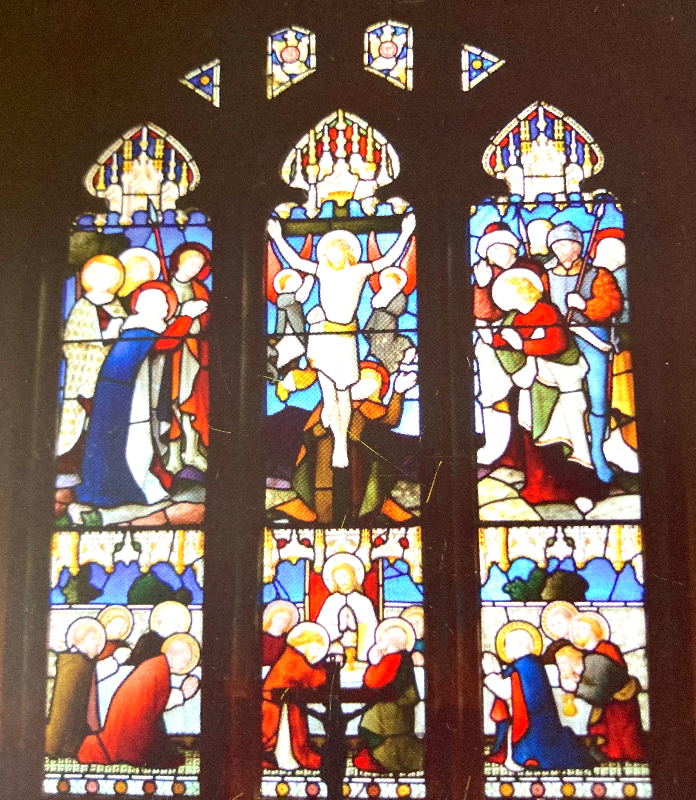
He stripped away medieval plaster work and crumbling, decaying earlier additions, he installed stained glass to brighten an interior that was otherwise dark and suffering from the ravages of time—not to mention the scars of the Reformation. The beam itself may have been a Victorian addition, installed by the Rector to commemorate the long held tradition that St. Edmund’s body rested here (about 869 AD)during its journey from London to Bury St. Edmund’s.
As you look around and take notice of the pulpit, donated to the church in 1698, the picture of St. Edmund’s death in the medieval style on the west wall, the Eagle lectern ,and the Tudor window located near the chancel on the left hand side, it’s all a fascinating history through time.
You’ll notice too the church still has a small and dark feel to it inside but the stained glass does brighten and open the whole church up, and on a sunny day I am sure light beams can be seen coming through both the coloured windows which fill with the figures of St. Edmund and St. Andrew. The latter to which the church is dedicated.

The Tolpuddle Connection and Hidden Gems
Before we conclude our tour, cast your eyes toward the simple wooden pews. While they may look humble, Greensted has a surprising link to social history. In 1834, several of the Tolpuddle Martyrs—the pioneers of trade unionism—lived in the parish after returning from their exile in Australia. One of them, James Brine, who lived in nearby New House Farm (now – Blackstock House) was married right here in this church, to one of his fellow martyrs daughters, and would have sat on these very benches. You’ll see they are boxed-in and with high panels with small access doors adding to the overall quaintness of this historic, haunting church.
Don’t miss the small “Leper’s Squint” window near the chancel. In the days when certain members of the community were cast out due to illness, they could still stand outside and peer through this tiny opening to witness the elevation of the Host during Mass. It’s a poignant reminder of the church’s role as a sanctuary for everyone, regardless of their status in the world.
Traveller’s Tips: If you’re visiting in the spring, the churchyard is often carpeted in primroses and violets, making the walk from the nearby town of Ongar even more magical. St. Andrew’s Church is open daily typically 9-4.
Not far away and on the London Road in Ongar, there is a nice traditional pub for refreshments – The Woodman (CM5 9QF) – A traditional Country Pub and Restaurant dating back to 1674, its sure to have seen many parishioners from St. Andrew’s in its time!
Until next time dear friends x