Exploring Clovelly the secret, timeless village in Devon and its real creator Christine Hamlyn, we look inside her private village.
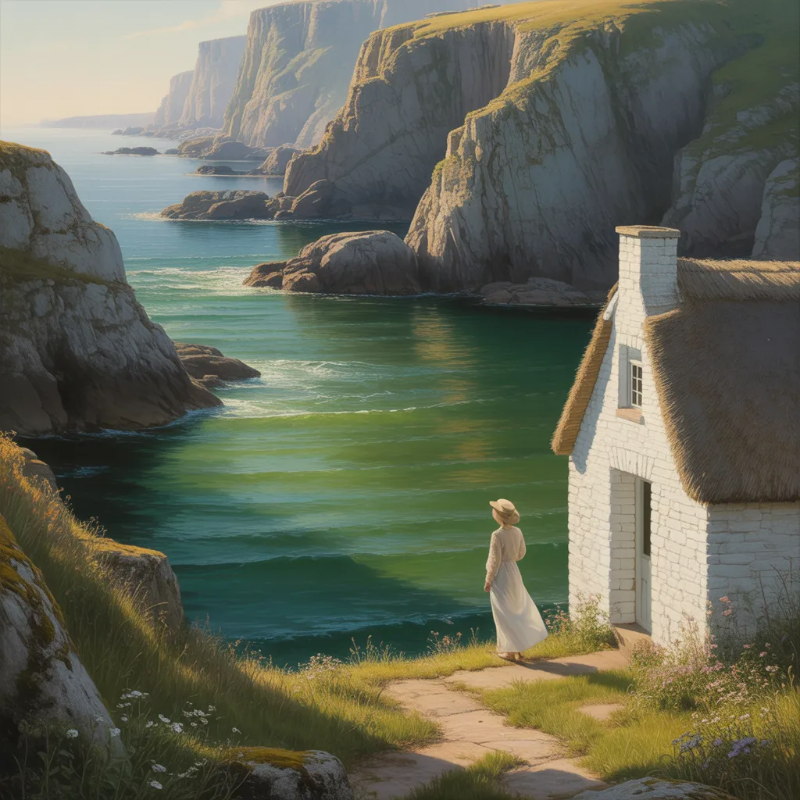
Clovelly might look like a postcard, but it sits on a stretch of coast known as the “Sailor’s Grave.” With 25 shipwrecks and many lives lost at nearby Morte Point, these waters have always been as dangerous as they are beautiful – let’s explore Clovelly and some of the secrets of this Devon village.
Built into a 400-foot cliff, the village was a perfect playground for smugglers and wreckers. Most of them were just locals trying to make ends meet, using the steep gradients to outrun the Excise men and hide their goods in the rock.
But the mystery goes deep in this timeless village and even deeper than hidden cellars. Locals whispered about “Sea Morgans”—green-haired, siren-like spirits lurking in the Bristol Channel. You have to wonder: were these stories just clever cover for smugglers moving contraband in the dark, or do the Morgans represent a wild, ancient energy that even the Hamlyn family’s stewardship can’t quite tame?
Smugglers, Shipwrecks, and Sea Morgans: The Dark History of the Sailor’s Grave
In the past, under the feudal system, people didn’t just rent land—they were legally tied to it and owned by their local Lord, it was a medieval hierarchy system where land was exchanged for labour, military service and loyalty. While most of Britain moved toward modern housing and a more independent way of life, the village of Clovelly stayed exactly as it was in the Middle Ages.
Well, kind of. In this post I’ll let you into a secret – Clovelly although as it looks to the modern day tourist as nothing has changed for hundreds of years; as a place set in time, it has actually seen a lot of changes and responsible mainly for these changes is a woman named Christine Hamlyn. She was of the 3rd family only in a unbroken line of about 800 years to have inherited Clovelly since the middle ages.

The Matriarch of the Manor: How Christine Hamlyn Saved a Living Time Capsule
It was Christine Hamlyn’s quest to improve Clovelly beyond all expectations and right up until 1936 she work with her husband to help the poor and deprived out of poverty, filthy conditions and improve the residents of Clovelly’s standard of living. She also had a head for business, we’ll talk of her in a moment..
To set the scene for you, the cobblestones of Clovelly do not belong to the feet of the residents who walk them. In a corner of North Devon where the land loses its battle with the Atlantic, there exists a living defiance of the modern world – a village of three hundred souls held in the palm of a single family’s hand. To enter Clovelly is to cross an invisible border into a private kingdom.
Imagine 200,000 people a year walking past your front door and wonder what you’re having for lunch. Living here means you’re basically a custodian of the view. You aren’t just a resident; you’re a key character in someone’s “dream England” holiday. It takes a certain kind of person to stay patient and polite while being the star of a three-hundred-year-old show, but that’s the deal when you live in a masterpiece.

Since 1738, the Hamlyn family has exercised absolute stewardship over every lintel, every leaf, and every life within these 400-foot cliffs. Although the people living here, are free to come and go as they please and work where they want, there are strict criteria when applying to live in Clovelly.
Christine Hamlyn inherited the Clovelly estate from her ancestors in 1884 and made it her life’s mission to save it from falling into ruin. When Christine inherited the estate, the village was a struggling, weathered fishing outpost. Inspired by the sudden fame brought to the area by Charles Kingsley’s (he did live here as a child for some time) novel Westward Ho!, she then realised that Clovelly’s future lay in its past.
Christine used her husband’s fortune ( he changed his own last name (Gosling) to Hamlyn by Royal Licence – often linked to inheriting a coat of Arms) to meticulously restore every single cottage. She fixed roofs, and added wherever she could the ornate, “chocolate box” details we see today, the carved lintels, the specific green trim, and the hanging flower baskets; all creating the village’s signature look.
As you walk down the cobbles, look for the initials CH (Christine Hamlyn) or FH (Frederick Hamlyn, her husband) followed by a date carved into the stonework. Those dates don’t mark when the house was built, but when Christine revamped them!
Living the “Down-a-Long” Life: Sledges, Donkeys, and the Art of Intentional Anachronism
It seems Christine was far more than a landlord; she was the village’s benevolent matriarch. She famously insisted on the exacting standards of beauty and conduct that defined the ‘Old Ways‘, yet she was deeply loved by the locals and celebrated as a ‘great hostess’ to her many influential friends. If you stay at the New Inn, you’ll find a portrait of her in her wedding dress—a haunting reminder of her grace. She had an absolute passion for beautiful things; one gets the sense that if people could be preserved as flawlessly as stone, Christine would have chosen to save the souls of Clovelly rather than just its buildings.

There is a particular kind of silence that comes with this total preservation. It is found in the uniform shade of “Clovelly Green” painted onto every window frame. This isn’t just a design choice; it is a signature of history. The visual effect is a village frozen in a colour that suggests a deep, almost obsessive attachment to the 19th century. It makes you think – Is Clovelly a sanctuary protected from the chaos of the 21st century, or is it a beautiful ghost kept from its natural rest by the sheer will of its tradition?
You cannot simply buy a house here. Rightmove is basically useless here, for the land remains whole and undivided under the estate.
You won’t find any ‘For Sale’ signs tacked to these stone walls, you can’t actually buy your way into the village. Instead, when a cottage becomes available you’ve got to sit down for an interview with the owners to prove you’re the right kind of guardian for such a legendary spot. To snag a key to this time capsule, you have to be ready to embrace a life of ‘intentional anachronism’—basically, you’re signing up to live in a beautiful, stubborn defiance of the modern world.
It is really peaceful here in a way, but there are a lot of tourists until the gates are shut at about 5:pm depending on the season. The unique peacefulness comes from the prohibition of cars as they are forbidden on the 20% gradient, and modern day delivery vans are not allowed of course! Don’t worry though- when you arrive there is a car park. Parking at the harbour is limited to guests staying at the Red Lion Hotel. You’ll find the visitors centre at the end of the B3237 at the top of the village, it has a cafe and shops. There are taxi’s that can take you from the car park to the harbour.

Up and Down the Old Way’s and the Middle-ages
Now lets get back to the Old Ways – Groceries and coal are still hauled on wooden sledges, it looks really bizarre; people, children, everyone pulling their shopping, furniture, tools around on wooden sledges up and down the lanes which are called up-a-long or down-a-long. Up-a-long is the name of the main street when you are walking up from the harbour toward the top of the cliff. And Down-a-Long is the same street, but it’s called “Down-a-Long” when you are heading down toward the sea.
So no Main Street or High Street here, just the echoing rhythm of life that pre-dates the engine. If you wander off the main path, you’ll find yourself in the ‘Backways’—the narrow, quiet veins of the village where the ghosts of smugglers and the scent of sea salt feel most at home.
Imagine living in a postcard. The locals basically act as guardians of the view, sharing their streets with thousands of tourists who show up just to see a place that honestly feels like it belongs in a history book.
Clovelly Manor ( once called a Court)is a private resident and allows no admission, however you can visit their gardens which have a lovely restored Victorian Greenhouse, open April through to September. Near to the manor is the church of All Saints, which is worth a visit and houses Christine’s departed family, open 9-5, it has toilets, a car park, a ramp, hearing loop, and large print if needed. There is a chapel – St. Peters down in the village also to visit, opening 9-4.

In this village, residents aren’t merely inhabitants; they are the latest actors in a three-hundred-year-old play, keeping the flame of the “Old Ways” alive and share them with the bigger population. When the Visitor’s Centre is shut and the gates are closed, I guess the local residents can relax back into their dream world. This is not a new phenomenon, there have been tourists coming to Clovelly since the mid 19th century, I’m sure Ms. Hamlyn would be pleased.
We may believe we have outrun the Middle Ages, but Clovelly remains a silent witness to the fact that the old ways of the feudal system still offer a strange, structured sanctuary from the modern world. It is a place held in balance by the will of the Estate and the weight of history—though as the mist rolls up the “Down-a-Long,” one can’t help but wonder if the village is truly anchored by the Hamlyn legacy, or if it is merely on loan from the Sea Morgans watching silently from the deep.
Most of the 70 or so buildings here in Clovelly are listed ( a structure that is of national, historic or architectural significant’s that is protected by law) and most too are pretty quaint but there are a few that hold some secrets – take number 53, said to be the oldest cottage in the village – ‘Crazy Kate’s ‘ – this is a story about a fisherman’s wife Kate Lyall who died in 1736 while living here she would watched her husband fishing in the bay. One day in despair and totally helpless she witnessed a storm swell develop and drowned her husband. It was said she went mad with grief, and not long after put on her wedding dress and walked into the sea to their watery grave to find him.
Until next time dear friends x