Discover how the city of Canterbury honors Geoffrey Chaucer, the Father of English Literature. Explore the immersive Canterbury Tales Experience, visit the dedicated Chaucer statue, and walk the historic route of the famous medieval pilgrims today.
Chaucer’s Legacy and Canterbury’s Charm: 5 Must-Do Things in the Historic City, plus 3 bonuses!
Geoffrey Chaucer is celebrated today as one of the great figures of English poetry. He was a multi-talented individual, recognised as a poet, author, philosopher, astronomer, diplomat, and civil servant. His high standing is underscored by the fact that he was the first person to be buried in Poets’ Corner in Westminster Abbey.
Having just gotten back from a visit to Canterbury made very famous by Geoffrey Chaucer and of course Thomas à Beckett (famously ‘killed’ by Henry ll) I was still filled with the joy of the place. There is so much to see and do, and as I left in the gloaming of the late day – leaving twinkling lights of the city and barely lit up ancient alleyways behind; there was an unquestionable feeling of “I’ve really got to come back soon!” – a clue to one of my bonuses for you if you’re interested in looking at the oldest church building in Britain still in use as a church; and it’s not the Abbey here at Canterbury!
We’ll start with a bit of history and Geoffrey Chaucer’s life and I will walk you through 5 must-do things to do and see in Canterbury. Parking is reasonable here and convenient and easy to use. The great Cathedral can be booked on-line or entry brought on the day of your visit; kids under 17 have free admission with 1 paying adult.

Early Life and Court Service of Geoffrey Chaucer
Chaucer was born around 1343 to a father who was a successful second-generation wine merchant, and quite well-off. It is thought he was born in London. While details of his early life are scarce, as a young man, he secured a position in the household of Elizabeth, Countess of Ulster, and her husband, Lionel, Earl of Ulster (later Duke of Clarence).
Chaucer served as a gentleman-in-waiting (or “gentleman’s gentleman”), providing domestic assistance while also contributing to the household’s entertainment. It was through this role that his talent for storytelling impressed his new employers.
His works performed at court, often in French by authors like Eustache Deschamps (a celebrated French poet)served as an early inspiration for the young Chaucer’s initial foray into poetry.

Military Service and Diplomacy
Chaucer’s life at court was interrupted by the unfolding of the Hundred Years’ War (triggered by a claim by Edward lll for the French throne).
In 1359, during Edward III’s invasion of France, Chaucer accompanied Lionel of Antwerp to the continent as part of the English army, and a year into the conflict, Chaucer was captured by the French during the siege of the city of Reims. Fortunately, King Edward III paid a big ransom to secure his release.
Through his involvement in aristocratic circles, Chaucer met John of Gaunt (an English Nobleman) who would later become a highly influential patron in Chaucer’s political career and an inspiration for one of his earliest poems, an elegy to Gaunt’s first wife Blanche of Lancaster entitled The Romaunt of the Rose.
Chaucer eventually served in the Royal Court of Edward III, undertaking various roles, including important diplomatic missions across Europe. His travels to France, Florence, and Genoa exposed him to the works of esteemed Continental authors like Boccaccio and Dante, who had a profound and enriching impact on his own writing
Political Career and The Canterbury Tales
Besides his obvious skill for poetry, Chaucer was highly proficient in the realms of politics and civil service.
In about 1386, he became a Member of Parliament for Kent and attended the famous Wonderful Parliament of November 1386, a session from October to November that year which attempted to reform King Richard II’s (Edward III’s successor) reform of his administration. Thereafter Chaucer continued to hold various important political and civil service positions throughout his illustrious career.
The Canterbury Tales – and his most famous work, is a compilation of 24 stories written in Middle English verse. The stories are framed by a group of pilgrims travelling from London to Canterbury to visit the shrine of Saint Thomas Becket at the Cathedral.
Scholars generally agree that this collection was not completely finished at the time of his death in 1400. But, considered a masterpiece that remains celebrated in theaters and literature today, with his linguistic choices still influencing modern vernacular.
The Tales are structured as a collection of stories told by a group of 31 pilgrims, including Chaucer himself, who gather at the Tabard Inn in Southwark. The Host or Inn keeper proposes that each pilgrim tell two tales on the way to Canterbury and two on the return journey to pass the time. The pilgrim who tells the best story will be rewarded with a free meal upon their return.
The whole thing features a vast and vivid array of characters, portraying different social statuses—from humble carpenters to noble knights. The stories and their tellers offer a highly realistic and often satirical social commentary on the 14th century, a bit like the tv programme Eastenders today I guess.
The Tales provide a rich, lively, and reliable account of 14th-century life, blending realism with outlandish vulgarity.
The work features important discussion on the Catholic Church and its experiences at the time. Its themes became intertwined with the religious and political ferment of the era, notably referencing the Lollardy movement—an English religious dissent headed by John Wycliffe (a Christian reformer and catholic priest).
Geoffrey Chaucer died on October 25, 1400, but his literary legacy, encapsulated by the unforgettable journeys and characters of The Canterbury Tales, continues to live on.

Planning a trip to Canterbury? You can literally walk in the footsteps of Chaucer’s pilgrims! Learn about the must-see Chaucer statue and the cutting-edge new Canterbury Tales Experience. His 14th-century masterpiece is still alive and well.
5 Major Attractions and Landmarks
The city’s commemoration of Chaucer is centred on recreating the medieval pilgrimage and celebrating the characters he created – Various guided tours are offered—often led by costumed guides—who walk groups through the medieval streets and lanes. These tours explore Chaucer’s life, visit his statue, and incorporate interactive storytelling of the Tales, highlighting how the setting of the city directly relates to his story.
- The Canterbury Tales Experience – This is the city’s main dedicated attraction, located in the historic centre. It is being updated as a cutting-edge immersive experience (set to fully launch late 2026). This attraction takes visitors on a sensory journey through the pilgrims’ route and vividly brings five of Chaucer’s most famous tales to life using special effects, projection mapping, and innovative storytelling.
- The Chaucer Statue – A larger-than-life bronze statue of Geoffrey Chaucer stands prominently in the city centre (at the corner of Best Lane and the High Street). He is depicted dressed as a pilgrim, and the detailed plinth features base-relief carvings of the 30 characters from The Canterbury Tales.
- Pilgrim Footsteps – The city itself serves as a living tribute, with tours and landmarks allowing visitors to trace the end of the pilgrimage – Travel through less frequented streets, discover places where poor pilgrims would have lodged and walked many years ago – follow their footsteps HERE – nearly 4 miles but it’s worth it!
- . Eastbridge Hospital of St Thomas the Martyr – This historic site, which Chaucer’s characters may have passed or stayed at, was founded in the 12th century to provide accommodation and hospitality for medieval pilgrims.After the martyrdom of Thomas à Beckett in 1170, the demand from pilgrims for hospitality at the monastery and Inns of Canterbury increased significantly – so a good merchant Edward FitzObold founded a hospice on Eastbridge to meet this need. Subsequent benefactors, grants and endowments were made to accommodate people on pilgrimage for a small price. When I visited (2025) It was closed for further repair which is a shame as there is a 13th century chapel, and some fabulous architecture to be seen, but accommodation is still available HERE
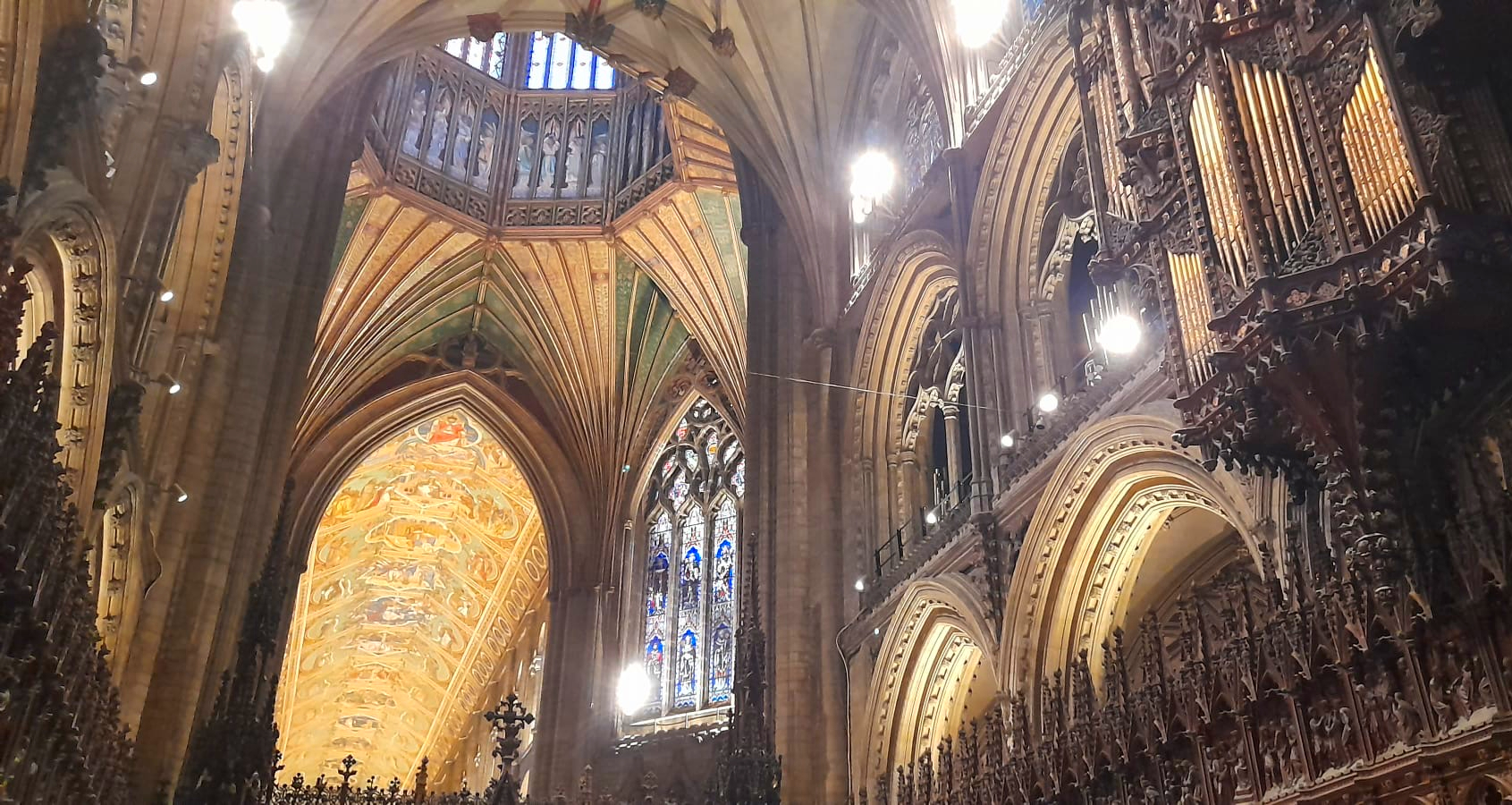
- Canterbury Cathedral – The ultimate destination of the fictional pilgrimage, where the pilgrims journeyed to the shrine of St. Thomas à Becket. HERE

Dare to Seek the Shadows? My 3 Bonuses for You
- We wouldn’t be able to end just here without giving you information about the highly popular walking ghost tour of Canterbury. Here you’ll hear about why you shouldn’t fool around with a Quija board, and be entertained by a mixture of haunting, humour and horror! The tour takes about 90 minutes and needs to be booked before hand for more information – HERE
- Maybe you fancy learning about ghosts, ghouls and the down-right creepy on the river? why not try an evening punt tour?
- HERE for your ghostly punt along the Kentish Stour.
- Do you love a church with a tale? Just outside the town not far from the great wall ( Roman and medieval defence walls surrounding the city and well worth the walk) you’ll find St. Martins Church, this ancient church of England parish church is recognised as the oldest existing parish in the English-speaking world. St. Martin’s was once the private chapel of Queen Betha of Kent (died about 600 AD). She was a Christian Frankish princess who was married to the pagan King Æthelberht of Kent, he gave her the building in which she renovated from the old Romano – British building. Lots to be seen here, plus a great graveyard; Mary Tourtel is buried here, she is the artist who created the famous tales and comic book strip featuring Rubert the Bear, which is a story loved by the people as much as any Canterbury Tale. St,Martins and St. Paul’s is on Church Street, CT1 1NH.

And while the Tales begin in London, it is in Canterbury where the pilgrimage concludes, ensuring that the city remains the quintessential destination for anyone celebrating the “Father of English Literature.”
The next time you visit, step off the beaten path, listen closely, and see if the past chooses to reveal itself to you. After all, the only way to truly understand a mystery is to become a part of it.
Until next time dear friends x